



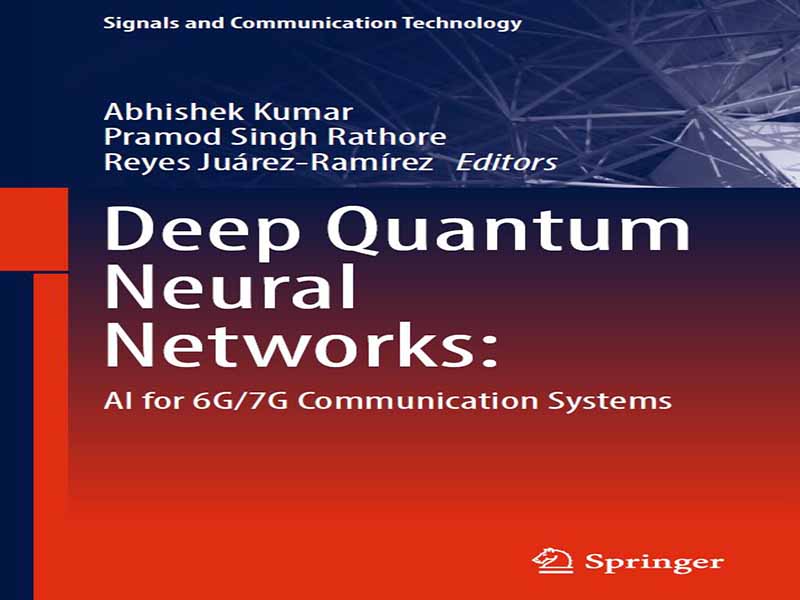
- عنوان کتاب: Deep Quantum Neural Networks AI for 6G7G Communication Systems
- نویسنده: Abhishek Kumar, Pramod Singh Rathore
- حوزه: شبکه عصبی
- سال انتشار: 2026
- تعداد صفحه: 243
- زبان اصلی: انگلیسی
- نوع فایل: pdf
- حجم فایل: 3.70 مگابایت
این جلد ویرایششده، شبکههای عصبی کوانتومی و پارادایمهای هوش مصنوعی در حال ظهور برای ارتباطات نسل بعدی و سیستمهای هوشمند، تحقیقات پیشگامی را در زمینه شبکههای عصبی کوانتومی (QNN)، هوش مصنوعی (AI) و کاربردهای آنها در حوزههایی مانند شبکههای 6G/7G، مراقبتهای بهداشتی و محیطهای هوشمند، سیستمهای صنعتی گرد هم میآورد. فصلهای این کتاب نشاندهنده تلاش مشترک محققان، دانشمندان و پزشکان از موسسات مختلف است که کاوشی عمیق از فناوریهای پیشرفته و پیامدهای آنها برای آیندههای پایدار و هوشمند ارائه میدهد.
This edited volume, Quantum Neural Networks and Emerging AI Paradigms for Next-Generation Communication and Intelligent Systems, brings together pioneering research in the field of Quantum Neural Networks (QNNs), Artificial Intelligence (AI), and their applications across domains such as 6G/7G networks, healthcare, industrial systems, and smart environments. The chapters in this book represent a collaborative effort of researchers, scientists, and practitioners from diverse institutions, providing an in-depth exploration of cutting-edge technologies and their implications for sustainable and intelligent futures. Chapter 1, explores a hybrid quantum-classical model that synergizes quantum neural networks with gradient boosting and random forest algorithms to optimize performance metrics like spectral efficiency and energy consumption in next-generation communication networks. Chapter 2, delves into the mathematical framework of tensor networks and their role in simplifying high-dimensional quantum state representations, thus enhancing the scalability, interpretability, and efficiency of QNNs in quantum machine learning tasks. Chapter 3, focuses on designing and implementing a wireless power transfer system for electric vehicles using resonant circuits, bridge rectifiers, and integrated coil systems to optimize efficiency and practical viability. Chapter 4, presents the fusion of Quantum Neural Networks and Edge Computing to enable real-time, low-latency, and secure data processing for applications such as healthcare monitoring, autonomous vehicles, and smart cities. Chapter 5, examines how QNNs, coupled with tensor networks and the emerging n-Sci framework, empower data-driven, secure, and efficient decision-making in healthcare, defense, and mission-critical systems. Chapter 6, further investigates the integration of QNNs into edge devices, high-lighting their potential for improving performance in real-time applications such as 5G/6G network optimization, fraud detection, and graph data analysis. Chapter 7, this chapter explains in detail the foundational principles of DQNs such as Q-value approximation, experience replay, and target networks, which make learning more stable and efficient. Practical applications such as Atari games prove that DQNs can learn optimal policies even from raw sensory input. The use of DQNs in robotics is growing rapidly for tasks such as navigation, obstacle avoidance, and precision control. Chapter 8, this chapter presents a multidisciplinary examination of E2EE, synthe-sizing insights from technical developments, practical implementations, and cross-domain challenges. We examine core encryption technologies—including AES, RSA, and Diffie-Hellman Key Exchange—while analyzing their deployment in platforms such as WhatsApp and their function in safeguarding contemporary communication Chapter 9, discusses the transformative impact of IoT, AI, and quantum tech-nologies on smart home ecosystems, focusing on energy efficiency, security, and intelligent automation compatible with 6G/7G standards. Chapter 10, introduces a novel architecture that leverages Virtual Reality, Digital Twin models, and QNNs in 6G-enabled environments for real-time, adaptive, and secure mental health therapy. Chapter 11, this chapter reviews the role of tensor networks (TNs) in the development of scalable quantum neural networks (QNNs), especially their joint hybridization with the neural network architectures in overcoming the quantum computing and machine learning challenges. With the help of the insights gained from recent advancement, we compare ten state of the art models that combine TNs, neural networks, and QNNs in integration. Results reveal that hybrid models highly increase performance, up to 96% accuracy, with a decrease in quantum circuit depth and better behavior of the entanglement entropy scalability. Analyzing graphs shows that tensor networks are particularly excellent in quantum simulations, image classification, and quantum chemistry, being inherently very noise-resistant on NISQ-era hardware. Chapter 12, the chapter focuses on adding QNNs to 7G wireless technology to enable better and safer connections for autonomous cars. We use ten recent, major studies to look at how quantum-based machine learning has led to better performance in terms of BER, energy saves and fast decisions in vehicular and UAV systems. Chapter 13, in this chapter, we present a CNN-based real-time system that is lightweight and was constructed using the Keras framework. To make our model more regionally adaptive, we trained it on traffic sign datasets from Saudi Arabia, Tunisia, Germany, and Italy. In order to ensure that the system can function in real-world settings with limited hardware resources, we also optimized it for edge devices like the Raspberry Pi and Jetson Nano. Chapter 14, this chapter underscores the practical advantages of HQCNNs in future intelligent networks, emphasizing their role in powering next-generation applications that demand both precision and speed. Through this framework, 6G/7G networks can achieve unprecedented levels of performance, reliability, and edge-based cognitive automation. Chapter 15, this chapter looks at QCNN architecture, signal mapping in real time and features an example on spectrum reuse. The chapter ends by examining the results of machine performance and the difficulties faced during its use in post-classical hardware situations.
این کتاب را میتوانید از لینک زیر بصورت رایگان دانلود کنید:
Download: Deep Quantum Neural Networks AI for 6G7G Communication Systems
















نظرات کاربران