







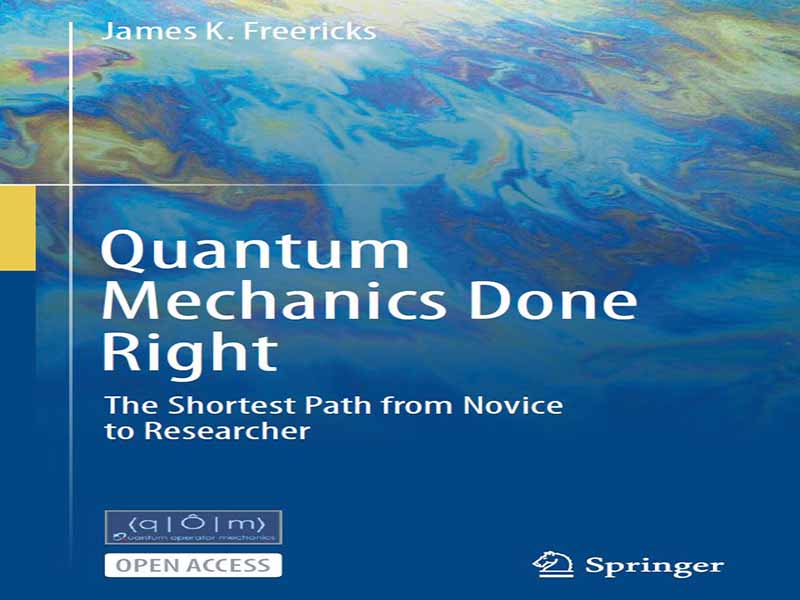
- عنوان کتاب: Quantum Mechanics Done Right 0The Shortest Path from Novice to Researcher
- نویسنده: James K. Freericks
- حوزه: مکانیک کوانتومی
- سال انتشار: 2026
- تعداد صفحه: 1453
- زبان اصلی: انگلیسی
- نوع فایل: pdf
- حجم فایل: 18.1 مگابایت
در این کتاب، به شما نشان خواهم داد که چگونه مکانیک کوانتومی «به درستی انجام میشود». مکانیک کوانتومی با همان الگویی تدریس شده است که در کتابهای درسی اصلی دهه ۱۹۳۰ توسعه داده شد، پس از جنگ جهانی دوم «مدرن» شد و سپس از آن زمان تاکنون تقریباً توسط همه کتابهای درسی پذیرفته شده است. مطمئناً، متون کوانتومی تفاوتهای خود را دارند، اما در عمل، همه آنها بر اساس یک روششناسی هستند – کار در مبنای مختصات-فضا با استفاده از معادلات دیفرانسیل؛ این امر در مورد رویکردهای اسپین-اول و معادله-اول شرودینگر نیز صادق است (زیرا تنها کاری که این دو مکتب انجام میدهند تغییر ترتیب ارائه مطالب یکسان است). چنین عملی شبیه به داشتن یک کتاب درسی مکانیک کلاسیک است که فقط از سیستم مختصات دکارتی استفاده میکند! همه ما میدانیم که مکانیک کوانتومی موضوعی دشوار است. خوشبختانه، اصول آموزشی توسعهیافته در تحقیقات آموزش فیزیک به ما میگویند که چگونه یادگیری را قابل دسترستر و مؤثرتر کنیم. این کتاب با در نظر گرفتن چنین اصولی ساختار یافته است. ما با توسعه ایدههای مفهومی شروع میکنیم، به توسعه ایدههای ریاضی و رسمی لازم میپردازیم و سپس آنها را در موقعیتهای تجربی به کار میبریم. این کتاب برای قابل دسترس بودن در نظر گرفته شده است، اما آسان نیست. ما فقط به یک پیشزمینه ریاضی در سطح دبیرستان (شامل جبر، هندسه و مثلثات) و درک انرژی و الکترومغناطیس در سطح دبیرستان نیاز داریم. بقیه موارد در اینجا توضیح داده شده است. اگر تا به حال به شما گفته شده است که برای آمادگی در مکانیک کوانتومی باید سالهای زیادی حساب دیفرانسیل و انتگرال (و جبر خطی) بخوانید و همچنین به چندین دوره فیزیک نیاز دارید، اکنون میدانید که این اشتباه است. اگر تحصیلات دبیرستانی دارید و به سختکوشی متعهد هستید، آماده هستید. پایه و اساس توسعه چنین رویکردی با راهحل پائولی برای هیدروژن در سال ۱۹۲۵ و مقالات مرتبط با آن توسط دیراک در سال ۱۹۲۶ آغاز شد، اما با توسعه روش فاکتورگیری شرودینگر در اوایل دهه ۱۹۴۰ به اوج خود رسید. هربرت گرین و هانس اوهانیان هر دو کتابهای درسی را توسعه دادند که از این اصول استفاده میکردند. اخیراً، ما این رویکرد را گسترش دادهایم تا از روشهای جبری برای تعیین توابع موج نیز استفاده کنیم. روح این کتاب مشابه متن آرنو بوهم است، اما با تمرکز بسیار متفاوت. کار سختی خواهد بود، اما ارزشش را دارد! اولین انقلاب کوانتومی (۱۹۰۰-۱۹۸۰) در مورد درک مکانیک کوانتومی و استفاده از اصول آن برای توسعه فناوریهایی (مانند لیزر و ترانزیستور) بود که از این اصول کوانتومی استفاده میکنند. اما اکنون ما در میانهی انقلاب کوانتومی دوم (۱۹۸۰-۱۹۸۰) هستیم. در اینجا میتوانیم کوانتومهای تکی اتمها، الکترونها و نور را مشاهده، دستکاری و کنترل کنیم. این امر منجر به فناوریهای جدیدی مانند سیستم موقعیتیابی جهانی (مبتنی بر ساعتهای اتمی) و رایانههای کوانتومی میشود. انقلاب کوانتومی دوم در حوزه جدید علم اطلاعات کوانتومی و سه ستون آن یعنی محاسبات کوانتومی، ارتباطات کوانتومی و حسگری کوانتومی خلاصه میشود. این کتاب بر جنبه حسگری کوانتومی علم اطلاعات کوانتومی تأکید دارد، اما به شما کمک میکند تا برای هر سه حوزه آماده شوید. این یک روش جدید برای آموزش مکانیک کوانتومی است که برای این انقلاب کوانتومی دوم ساخته شده است. من آن را مکانیک عملگر کوانتومی مینامم تا آن را از مکانیک ماتریسی یا مکانیک موجی انقلاب کوانتومی اول متمایز کنم. استراتژی من این است که مواد را با در نظر گرفتن قابلیت دسترسی طراحی کنم، اما هیچ یک از بخشهای این علم را رقیق یا اصلاح نکنم. برعکس، ما اغلب مطالب بیشتری از آنچه در متون مرسوم پیدا میکنید، پوشش میدهیم و مطمئناً مطالب بیشتری را پوشش میدهیم که مستقیماً به آزمایشها مربوط میشوند. قابل فهم بودن به معنای آسان بودن نیست. این کتاب به مطالعه و تلاش متمرکز برای مطالعه همه مطالب نیاز دارد. این کتاب برای چه کسانی مناسب است؟ اول و مهمتر از همه، برای کسانی است که میخواهند مکانیک کوانتومی را مطالعه کنند، اما پیشنیازهای مرسوم را نگذراندهاند. اما، هر کسی که قبلاً مکانیک کوانتومی را مطالعه کرده باشد، ایدهها و دیدگاههای جدید و تازهای را نیز در این کتاب خواهد یافت. به خصوص به این دلیل که ما بر یک روش مستقل از نمایش برای ارائه مکانیک کوانتومی تأکید داریم. من معتقدم که همه خوانندگان در مطالب ارائه شده در اینجا چیز جدیدی خواهند دید – حتی یک مکانیک کوانتومی مادام العمر! مطمئن باشید که مکانیک کوانتومی دشوار است. اما هرگز نباید از تلاش برای درک چیزی صرفاً به دلیل سخت بودن آن دست بکشید. من اغلب در کلاسهایم در جورج تاون به دانشجویان کارشناسی میگویم که یک روش رایج برای اثبات یک نتیجه وجود دارد که اساتید، دستیاران آموزشی و حتی همسالان از آن استفاده میکنند. به آن اثبات با ارعاب میگویند. این زمانی است که کسی که از شما اقتدار بالاتری دارد، چیزی را توضیح نمیدهد، اما ادعا میکند که درست است. آنها اغلب با این تلقین پایان مییابند که شما باید خنگ باشید تا آن را نفهمید. شما هم میپذیرید که این موضوع درست است و هم اینکه قادر به درک آن نیستید. این غیرقابل قبول است. هرگز نباید به خودتان اجازه دهید که از نظر تحصیلی مورد آزار و اذیت قرار بگیرید. اعتقاد من این است که هیچ چیز فراتر از این نیست که کسی با تحصیلات دبیرستانی بتواند آن را توضیح دهد و بفهمد. بنابراین، اگر تا به حال به این فکر کردهاید که دنیای کوانتومی چیست، اینجا…
In this book, I will show you how quantum mechanics is “done right.” Quantum mechanics has been taught with the same paradigm that was developed in the original textbooks of the 1930s, “modernized” after World War II and then adopted by nearly all textbooks since then. Sure, quantum texts have their differences, but in practice, they are all based on the same methodology—working in the coordinate-space basis using differential equations; this holds for spins-first and Schrödinger-equation-first approaches (because all these two schools do is change the order in which the same materials are presented). Such a practice is similar to having a classical mechanics textbook that uses only the Cartesian coordinate system! We all know quantum mechanics is a difficult subject. Fortunately, the didactic principles developed in physics education research tell us how to make learning more accessible and more effective. This book is structured with such principles in mind. We begin by developing the conceptual ideas, move onto developing the requisite math and formal ideas, and then apply them to experimental situations. This book is intended to be accessible but it is not easy. We only require a highschool- level math background (including algebra, geometry, and trigonometry) and a high-school-level understanding of energy and electromagnetism. All the rest is developed here. If you have ever been told you need to study many years of calculus (and linear algebra) and that you also need multiple physics courses to be ready for quantum mechanics, you now know this is wrong. If you have a high school education, and a commitment to hard work, you are ready. The foundation for developing such an approach started with Pauli’s solution of hydrogen in 1925 and related papers by Dirac in 1926, but it came to the fore with the development of the Schrödinger factorization method in the early 1940s. Herbert Green and Hans Ohanian both developed textbooks that used these principles. Recently, we have expanded this approach to use algebraic methods to determine wavefunctions as well. The spirit of this book is similar to that of Arno Bohm’s text, but with a very different focus. It will be hard work, but it is so worth it! The first quantum revolution (1900–1980) was about understanding quantum mechanics and using its principles to develop technologies (such as the laser and the transistor) that use these quantum principles. But now we are in the midst of the second quantum revolution (1980–). Here, we can observe, manipulate, and control the individual quanta of atoms, electrons, and light. This is ushering in new technologies, such as the global positioning system (based on atomic clocks) and quantum computers. The second quantum revolution is summarized in the new field of quantum information science and its three pillars of quantum computing, quantum communication, and quantum sensing. This book emphasizes the quantum sensing side of quantum information science, but it will help you prepare for all three areas. It is a new way of teaching quantum mechanics, built for this second quantum revolution. I call it quantum operator mechanics, to differentiate it from the first quantum revolution’s matrix mechanics or wave mechanics. My strategy is to design the materials with accessibility in mind, but not to dilute or modify any of the science; on the contrary, we often cover more than what you will find in conventional texts, and certainly we cover more material that is related directly to experiments. Accessible does not mean easy. This book will take concentrated study and effort to get through all of it. Who is this book for? First and foremost, it is for those who want to study quantum mechanics, but have not taken the conventional prerequisites. But, anyone who has studied quantum mechanics before will also find fresh new ideas and perspectives in this book. Especially so, because we emphasize a representation independent way of presenting quantum mechanics. I believe all readers will see something new in the material presented here—even a lifelong quantum mechanic! Rest assured that quantum mechanics is difficult. But you should never give up on trying to understand something simply because it is hard. I often tell undergraduates in my classes at Georgetown that there is a common method of proving a result that professors, teaching assistants, and even peers will use. It is called proof by intimidation. This is when someone of higher authority than you fails to explain something, but asserts it is true. They often end by intimating that you must be dense not to get it. You walk away accepting both that it is true and that you are incapable of understanding it. This is unacceptable. You should never allow yourself to be academically bullied. My belief is that nothing is beyond being able to be explained and understood by someone with a high school education. So, if you have ever wondered what the quantum world is all about, here is your chance to explore it. There will be no proof by intimidation, only proof by understanding. Yes, you can do it. If you find that scientific and mathematical material was often confusing to you, my pledge is to get you through this material if you can invest the time and effort to ask why and to persist until you will eventually be able to say “I understand.” The first four chapters are dedicated to developing the conceptual ideas of superposition, complementarity, measurement, tagging, and entanglement by examining spin in atoms and the quantum properties of light. Once the conceptual ideas are in hand, we then move into developing some mathematical skills (based on the high school algebra and trigonometry sequences) that will be needed for the more formal work (complex numbers, exponentials, 2 × 2. matrices, · · · .). Chapters 6–12 then cover much of the time-independent material found in conventional undergraduate and graduate texts, but we also discuss spin models, which are rarely covered in either. Then we have another mathematical interlude in Chap. 13, which discusses some of the more advanced mathematical ideas needed (primarily in linear algebra). The last third of the book focuses on time-dependent phenomena and second quantization of electrons and photons. We even describe how the laser interferometry gravitational-wave observatory works—one of the quantum engineering marvels of the twenty-first century. If you want even more details of what is in the book, please browse the Table of Contents. Every chapter starts with a quote from great thinkers who are not scientists (except for one). Enjoy their wisdom. If you have been paying attention, you heard me right. We will be taking you through most of the undergraduate and graduate quantum mechanics curriculum in a book that uses no calculus. We will do this without sacrificing rigor, and we will cover more material than is usually found in those texts. There is one small price we do pay for this. We will not cover perturbation theory, scattering theory, or semiclassics here, as they all require some calculus to do it right. Will you really become a quantum mechanic after finishing this book? You bet you will! By this, I mean that you actually will have the skills to contribute to mentored research on quantum mechanics. How do I know this? Because I have already done this numerous times with students and citizens who have had an interest in quantum mechanics and who have worked through early versions of these materials. So it really does work and it really prepares you to tackle quantum ideas at a high level. Let me end by discussing my motivation for creating this work. I am a throughand- through quantum mechanic. I find this field fascinating and nearly all of my research is in the area of quantum mechanics. Currently, this field is restricted to experts only, with stark warnings that one must prepare for years to be allowed to sit at the table (just search for the math preparation needed for quantum mechanics on Quora and you will see what I mean). Rubbish! Quantum mechanics is one of the pinnacles of human intellectual development. Everyone should know something about it and those who wish to know more should be able to do so without being forced to spend many years to do so. This is what motivated me to write this book and it also motivated me to create online courses that bring this material to everyone. In order to bring this work to the widest possible audience, I have made the electronic version open access, available to everyone. This comes at a rather significant cost, so I do ask if you find this work useful to you and you have the means to do so, to also purchase the hard cover version of the book. This helps support additional work (and I do have a few more book ideas I am working on). Because the work is open access, all original materials are available for noncommercial re-use. I do include some copyrighted materials in this work and they are clearly described as such where they appear. That material is expressly not available for re-use without requesting permission from the copyright holder. Many of the figures in this book are pictures of the original researchers in the field. I have modified them to look like sketches using the software graphite. I did this to make them all have a similar feel as you see them in the work. The electronic version of the book does have a number of live links in it (tiny urls are available in the print book). We have striven to make links to the most permanent locations we could find, but I apologize that some links may become stale over time. If so, a quick google search will hopefully find what you are looking for. I have a YouTube channel quantum4everyone https://tinyurl.com/bdhssec5, a Quora feed quora-freericks https://tinyurl.com/ 284mbu6x, and a local site quantum.georgetown.domains https://tinyurl.com/ 4u9dbmxz that provides a repository for my work on quantum mechanics pedagogy. In addition, the computer tutorials are available for downloading at github https://tinyurl.com/43e487wu. Finally, I created a customized YouTube playlist for the book https://tinyurl.com/yt2895u3, which has a video describing the contents of each chapter, as well as some of its special features. It starts with Quantum Mechanics Done Right https://tinyurl.com/3y2ff55e, The Origins of the Book https://tinyurl.com/hbsjw4zf, and Accessibility versus Easy https://tinyurl.com/2vmmh3zn. I hope you will enjoy these additional resources. Come and join the fun! Learn how to become a quantum mechanic. You already have all the background you will need.
این کتاب را میتوانید از لینک زیر بصورت رایگان دانلود کنید:
Download: Quantum Mechanics Done Right




















نظرات کاربران