



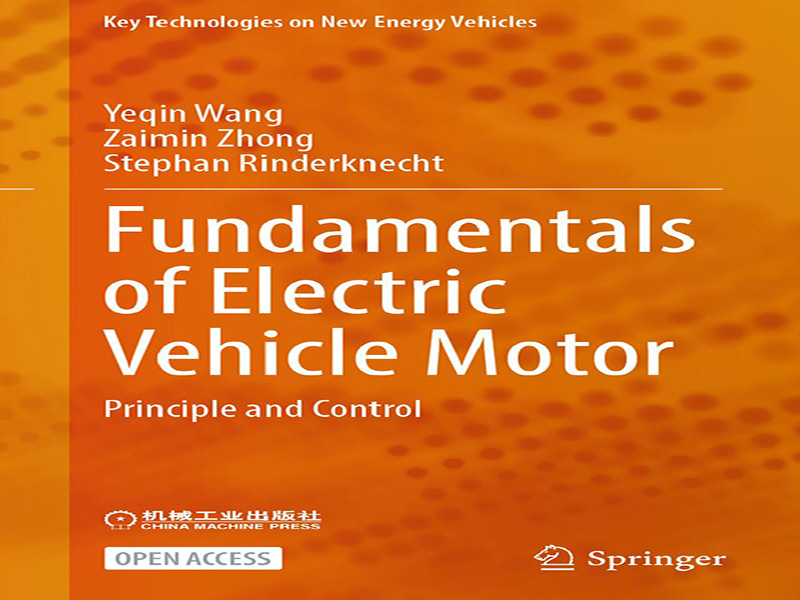
- عنوان کتاب: Fundamentals of Electric Vehicle Motor Principle and Control
- نویسنده: Yeqin Wang, Zaimin Zhong
- حوزه: اتومبیل برقی
- سال انتشار: 2026
- تعداد صفحه: 473
- زبان اصلی: انگلیسی
- نوع فایل: pdf
- حجم فایل: 12.6 مگابایت
به عنوان اجزای اساسی برای تبدیل انرژی الکترومکانیکی، ماشینهای الکتریکی جایگاه محوری و فزایندهای در صنایع مختلف دارند. از نظر ویژگی های خروجی، ماشین های الکتریکی ذاتا دارای عملکرد دینامیکی و حالت پایدار عالی هستند. بنابراین، در بسیاری از سناریوهای کاربردی، ماشین الکتریکی را می توان از ماشین آلات بار جدا کرد. یعنی می توان آن را به عنوان یک منبع گشتاور ایده آل یا منبع سرعت، بدون در نظر گرفتن ویژگی های غیر ایده آل آن مانند عملکرد دینامیکی و ویژگی های بار درک کرد. این اجازه می دهد تا ماشین الکتریکی را مستقل از بار یا ماشین آلات کار کنترل کنید. با این حال، با گسترش روزافزون کاربرد ماشینهای الکتریکی، اتصال بین ماشین و ماشینهای بار از نظر انرژی و اطلاعات در بسیاری از موارد تنگتر میشود و در نظر گرفتن ویژگیهای الکترومغناطیسی خود ماشین ضروری است. به ویژه، در بسیاری از زمینه های کاربردی، ماشین های الکتریکی به شدت با تجهیزات کاربردی هم از نظر مکانیکی و هم از نظر الکتریکی ادغام می شوند که منجر به افزایش تخصص می شود. چنین سناریوهایی در صنایع مختلف و زمینه های کاربردی مانند وسایل نقلیه الکتریکی، رباتیک و مکاترونیک مشهود است. بنابراین، درک جامع و دقیق از فرآیند تبدیل انرژی الکترومکانیکی در ماشینهای الکتریکی به دانش پایه حرفهای برای بسیاری از رشتههای مهندسی غیرالکتریک تبدیل شده است. این کتاب درسی برای پاسخگویی به نیازهای آموزشی چنین رشته های کالج تدوین و تنظیم شده است. این نسخه انگلیسی بر اساس نسخه دوم چینی ترجمه، تکمیل و گردآوری شده است. محتوای کتاب در سه بخش تنظیم شده است. بخش اول دانش پایه را پوشش می دهد، با هدف خوانندگان برای ایجاد یا تقویت مفاهیم اساسی سیستم های الکترومغناطیسی و تسلط بر روش های تجزیه و تحلیل عمومی برای سیستم های الکترومغناطیسی.
As fundamental components for electromechanical energy conversion, electric machines hold a pivotal and increasingly important position across various industries. In terms of output characteristics, electric machines inherently possess excellent dynamic and steady-state performance. Therefore, in many application scenarios, the electric machine can be decoupled from the load machinery; that is, it can be understood as an ideal torque source or speed source, without considering its non-ideal characteristics such as dynamic performance and load characteristics. This allows for controlling the electric machine independently of the load or working machinery. However, with the increasingly widespread application of electric machines, the coupling between the machine and the load machinery in terms of energy and information is becoming tighter in many cases, making it necessary to consider the electromagnetic characteristics of the machine itself. Particularly, in many application fields, electric machines are highly integrated with application equipment both mechanically and electrically, leading to increasing specialization. Such scenarios are evident in various industries and application fields like electric vehicles, robotics, and mechatronics. Therefore, a comprehensive and accurate understanding of the electromechanical energy conversion process in electric machines has become essential professional foundational knowledge for many nonelectric engineering majors. This textbook is compiled and organized to meet the teaching needs of such college majors. This English edition is translated, supplemented, and compiled based on the second Chinese edition. The content of the book is organized into three sections. The first section covers foundational knowledge, aiming for readers to establish or strengthen the basic concepts of electromagnetic systems and master general analysis methods for electromagnetic systems. This includes the first three chapters. Chapter 1, Introduction, primarily outlines the development history of electric drive technology and the current application overview of electric drive systems for vehicles. Chapter 2 introduces magnetic fields and magnetic circuits, introducing typical DC and AC magnetic circuits. Chapter 3 analyzes the basic principles of electromechanical energy conversion and its unified mathematical expression from an energy perspective. The second section introduces the basic operating principles of AC machines and the fundamentals of vector control, comprising four chapters. Among them, Chap. 4 quantitatively introduces the laws of electromechanical energy conversion in AC machines by introducing the four-coil primitive electric machine model. Chapter 5 comprehensively covers the structural forms of windings and their mathematical characterization and fully introduces the mathematical representation and operations of space vectors. Chapters 6 and 7 introduce the operating principles, space vector models, and field oriented control concepts of permanent magnet synchronous motors and induction motors, respectively. The third section covers topics related to the integrated control of vehicle electric drive systems. Chapter 8 introduces the principles of space vector pulse width modulation and the fundamentals of power semiconductor technology. Chapter 9 discusses the main issues to consider for the integration of vehicle motor drive systems. The key characteristics of this textbook are as follows. Firstly, this book emphasizes the role of space vectors in the analysis of electric machines and their control, continuously reinforcing and repeatedly applying space vectors as a unified mathematical methodology. The space vector analysis method is chosen as it is a fundamental mathematical tool in many disciplines such as mechanics and mechanical vibrations. Secondly, the concept of “Entrainment EMF” is introduced. Its practical value lies in the ability to directly establish the voltage vector equation of the motor in the motion reference frame without the need for a coordinate transformation process. This facilitates understanding, allowing for an expansion of teaching depth. Besides, a four-coil primitive electric machine model is introduced, which provides a unified introduction to the basic working principle of AC machines and their mathematical representation. The field of electric machine theory and control technology is complete with numerous esteemed predecessors and masters. The authors have no intention of overstepping boundaries or presumptuously composing texts, but merely seek to provide readers with one more option. Omissions in citations and any inadequacies in the text are sincerely open to criticism and correction.
این کتاب را میتوانید از لینک زیر بصورت رایگان دانلود کنید:
Download: Fundamentals of Electric Vehicle Motor Principle and Control
















نظرات کاربران