



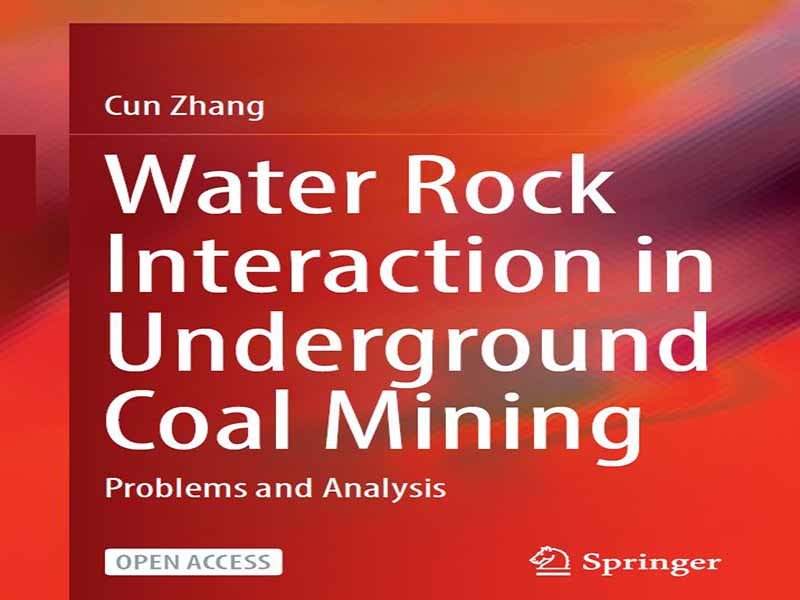
- عنوان کتاب: Water Rock Interaction in Underground Coal Mining Problems and Analysis
- نویسنده: Cun Zhang
- حوزه: مهندسی معدن
- سال انتشار: 2026
- تعداد صفحه: 180
- زبان اصلی: انگلیسی
- نوع فایل: pdf
- حجم فایل: 5.50 مگابایت
برهمکنش آب و سنگ (WRI) یکی از موضوعات تحقیقاتی مورد توجه در زمینه زمینشناسی و مهندسی ژئوتکنیک است. بسیاری از واکنشهای فیزیکی و شیمیایی در فرآیند WRI دخیل هستند، که عمدتاً شامل روانکاری، رسوبگذاری، اکسیداسیون-احیا، تبادل یونی و غیره میشوند. بسیاری از خطرات زمینشناسی و مشکلات ایمنی مهندسی به WRI مربوط میشوند، مانند پایداری شیب، پایداری سد مخزنی، ترکیدن سنگ، ریزش کارست و هجوم آب. تأثیر آب بر رفتار مکانیکی و تراوش توده سنگ، اساس تجزیه و تحلیل و تفسیر مشکلات ذکر شده در بالا است. در سالهای اخیر، تحقیقات زیادی به بررسی تأثیر آب بر ویژگیهای مکانیکی سنگ پرداختهاند. به طور کلی مشخص شده است که وجود آب، پارامترهای مکانیکی (مانند مدول الاستیک، مقاومت فشاری، چسبندگی و مقاومت کششی) و همچنین خاصیت شکنندگی سنگ را تضعیف میکند و همچنین توزیع خردایش را پس از شکست سنگ تغییر میدهد. از یک سو، وجود آب، فشار منفذی در توده خاک و سنگ را افزایش میدهد که باعث کاهش تنش مؤثر ذرات اسکلت در محیط میشود و در نتیجه پارامترهای فیزیکی و مکانیکی محیط را تغییر میدهد. از سوی دیگر، آب ممکن است ترکیبات معدنی و سیمان بین دانهها را حل کند و ترکیبات معدنی جدیدی تولید کند. اگر آب حاوی برخی از اجزای معدنی خورنده باشد، شاخص آب زیرزمینی (WRI) جدیتر خواهد بود. به عنوان مثال، سنگهایی با محتوای کانیهای رسی بالاتر، بیشتر در معرض آب قرار دارند. سفرههای آب زیرزمینی زیادی در لایههای اندازهگیری زغال سنگ وجود دارد و فعالیتهای استخراج زغال سنگ این سفرههای آب زیرزمینی را مختل میکند. بنابراین، اجتنابناپذیر است که آب به مناطق استخراج شده جریان یابد و ایمنی معدن را تهدید کند و حتی باعث حوادث هجوم آب شود. علاوه بر این، سازههای سنگی زیرزمینی تحت تأثیر نرم شدن آب، بیشتر بیثبات میشوند که ممکن است منجر به حوادث ایمنی شود. فاجعه آب معدن به عنوان یکی از مهمترین مشکلات در معدن زغال سنگ در نظر گرفته میشود و بنابراین، یک کانون تحقیقاتی در معدن زغال سنگ بوده است. فرآیند WRI نقش مهمی در بلایای مرتبط با آب دارد و کلید کشف مکانیسمهای زیربنایی این بلایا است. هدف این کتاب بررسی و مطالعهی WRI در محیطهای معدن زغالسنگ است. این کتاب به هفت فصل تقسیم شده است. در این هفت فصل، فصل 1 مروری بر ادبیات مربوط به مشکلات WRI که ممکن است در محیطهای معدن زغالسنگ رخ دهد، ارائه میدهد. برای هر مشکل، مهمترین ویژگیهای WRI نشان داده شده است. روشهای تجزیه و تحلیل آزمایشگاهی و معیارهای مربوط به WRI ارائه شده است و نتیجهگیریهای اولیه در مورد مشکلات (1) تضعیف آب سنگ بکر، (2) ویژگیهای جریان تنش توده سنگ شکستگی و (3) ویژگیهای جریان تراکم توده سنگ شکسته بیان شده است. روشهای شبیهسازی WRI در یک محیط معدن زغالسنگ در فصل 1 خلاصه شدهاند که میتوان آنها را به طور کلی به روش شبیهسازی توده سنگ پیوسته و روش شبیهسازی توده سنگ شکسته تقسیم کرد. قابلیتها و محدودیتهای آنها نیز مورد بحث قرار گرفته است. در نهایت، نتیجهگیری و چشماندازها در فصل 1 ارائه شده است. فصل 2 بر تضعیف آب در مقاومت سنگ و عوامل مؤثر بر آن (محتوای آب، زمان غوطهوری و چرخههای تر و خشک شدن) تمرکز دارد. مقاومت توده سنگ با توجه به میزان آب، زمان غوطهوری و چرخههای تر و خشک شدن، بسته به نوع توده سنگ و ترکیب معدنی، به درجات مختلفی کاهش مییابد. تعداد و شدت انتشار صوتی مربوطه و شدت تابش مادون قرمز نیز به همین ترتیب تضعیف میشوند. WRI پلاستیسیته توده سنگ را افزایش داده و شکنندگی آن را کاهش میدهد. روشهای میکروسکوپی مختلفی برای مطالعه توصیف منافذ و مکانیسم تضعیف WRI مقایسه و تجزیه و تحلیل میشوند. روشهای مختلفی باید برای مطالعه جامع تکامل منافذ WRI اتخاذ شود. از روشهای میکروسکوپی برای مطالعه مکانیسم تضعیف WRI استفاده میشود. در کارهای آینده، پارامترهای مکانیکی سنگهای ضعیف شده تحت غوطهوری طولانی مدت در آب (طی سالها) باید در نظر گرفته شود و توجه بیشتری به نحوه اعمال مقیاس آزمایشگاهی به مقیاس مهندسی شود. فصل 3 روشی را برای تعیین مقدار آستانه اجزای معدنی مختلف و منافذ داخل نمونه زغال سنگ از طریق اسکن توموگرافی کامپیوتری (CT)، آزمایش پراش سنج اشعه ایکس (XRD) و فناوری رزونانس مغناطیسی هستهای (NMR) پیشنهاد میکند. این روش تخلخل زغال سنگ را با NMR تعیین میکند و سپس آستانه بازسازی منافذ را تعیین میکند. نوع و ترکیب کانیهای نمونه زغالسنگ توسط XRD تعیین شد. با ترکیب اختلاف در چگالی هر کانی، آستانه طبقهبندی هر نوع کانی قابل تعیین است. ابتدا حجم اولیه نماینده را از طریق بازسازی منافذ و کانیهای زغالسنگ با اندازههای مختلف تعیین کردیم. بر این اساس، سه مکعب با طول ضلع 300 پیکسل و موقعیتهای مختلف برای بازسازی منافذ و کانیها انتخاب کردیم…
The water-rock interaction (WRI) is one of the research focuses in the field of geology and geotechnical engineering. Many physical and chemical reactions are involved in the process of WRI, mainly including lubrication, precipitation, oxidation- reduction, ion-exchange, etc. Many geological hazards and engineering safety problems relate to WRI, e.g., slope stability, reservoir dam stability, rock bursting, karst collapses, and water inrush. The influence of water on the mechanical and seepage behavior of rock mass is the basis for the analysis and interpretation of the problems mentioned above. In recent years, a large body of research has investigated the effect of water on rock mechanical characteristics. It is generally found that the presence of water weakens the mechanical parameters (e.g., elastic modulus, compressive strength, cohesion, and tensile strength) as well as the brittle property of a rock, and also changes the fragmentation distribution after rock failure. On the one hand, the existence of water increases the pore pressure in soil and rock mass, which reduces the effective stress of skeleton particles in the medium, so as to change the physical and mechanical parameters of the media. On the other hand, the water may dissolve mineral compositions and cement between grains, so as to produce new mineral compositions. If the water contains some corrosive mineral components, the WRI would be more serious. For example, rocks with higher clay mineral contents are more susceptible to water. There are many aquifers in coal measure strata, and coal mining activities disturb these aquifers. Therefore, it is inevitable that water would flow into mined areas, threatening mining safety and even causing water inrush accidents. In addition, underground rock structures are further destabilized under the softening effect of water, which might result in safety accidents. Mine water disaster is regarded as one of the most critical problems in coal mining, and thus, has been a research hotspot in coal mining. The WRI process plays a significant role in water-related disasters and is the key to uncover the mechanisms underlying these disasters. The objective of this book is to review and study the WRI in coal mining environments. This book is divided into seven chapters. Within those seven chapters, Chap. 1 gives a literature review on the WRI problems that may occur in coal mining environments. For each problem, the most important characteristics of WRI are illustrated. Laboratory analysis methods and relevant measures of WRI are presented, and primary conclusions on problems of (1) water weakening of intact rock, (2) stress-flow characteristics of fracture rock mass, and (3) compaction-flow characteristics of broken rock mass are outlined. Simulation methods of WRI in a coal mining environment are summarized in Chap. 1, which can be generally divided into continuous rock mass simulation method and broken rock mass simulation method. Their capabilities and limitations are also discussed. Finally, concluding remarks and prospects are presented in Chap. 1. Chapter 2 focuses on the water weakening of rock strength and its influencing factors (water content, immersion time, and wetting–drying cycles). The strength of the rock mass decreases to varying degrees with water content, immersion time, and wetting–drying cycles depending on the rock mass type and mineral composition. The corresponding acoustic emission count and intensity and infrared radiation intensity also weaken accordingly. WRI enhances the plasticity of rock mass and reduces its brittleness. Various microscopic methods for studying the pore characterization and weakening mechanism of the WRI are compared and analyzed. Various methods should be adopted to study the pore evolution of WRI comprehensively. Microscopic methods are used to study the weakening mechanism of WRI. In future work, the mechanical parameters of rocks weakened under long-term water immersion (over years) should be considered, and more attention should be paid to how the laboratory scale is applied to the engineering scale. Chapter 3 proposes a method to determine the threshold value of various mineral components and pores inside the coal sample through computed tomography (CT) scanning, X-ray diffractometer (XRD) test, and nuclear magnetic resonance (NMR) technology. This method determines the porosity of the coal by NMR and then determines the pore reconstruction threshold. The type and composition of coal sample minerals were determined by XRD. Combined with the difference in the density of each mineral, the classification threshold of each type of mineral can be determined. We first determined the representative elementary volume through pore and mineral reconstruction of coal with different sizes. On this basis, we selected three cubes with a side length of 300 pixels and different positions for pore and mineral reconstruction. The extraction of different mineral components is helpful for the research on the evolution of various minerals before and after water immersion. In Chap. 4, the evolution of pore structure and mechanical behavior of sandstones at different immersion times (0d, 3d, 30d, 90d, 180d, and 360d) are studied. A series of physico-chemical experiments and uniaxial compression tests (with simultaneous acquisition of acoustic emission (AE) signals) are conducted to explore the weakening mechanism and failure mode of sandstones during long-term immersion. Variation of sandstone pore structure during long-term immersion is revealed using multi-parameter. The weakening mechanism of WRI under longterm immersion conditions is explained. The study results enhance our understanding of weakening mechanisms at long-term immersion and provide a basis for assessing the long-term stability of underground engineering. Chapter 5 proposes the simulation methods of fluid-solid coupling for water immersion weakening in coal mining. The permeability and strength of coal-rock mass can be realized to update real-time during mining and water immersing in the methods. The implementation process of the simulation is discussed with the discrete element method and finite element method. The permeability is updated through stress and crack opening in the discrete element simulation method. Meanwhile, the variable joint stiffness simulation method that considers changes in crack compressibility is proposed. When the water seeps into the joint crack, the update of the water content is calculated by the change in joint opening. Before the coal-rock mass is yielded, the weakening strength is updated based on the relationship between water content and coal-rock mass strength. Compared with the discrete element simulation method, the update of the permeability is needed to consider anisotropy in the finite element simulation method. The update of the saturated water content is calculated based on the porosity. Finally, the fluid-solid coupling simulation method of water immersion weakening proposed is discussed and prospected. It is considered to be more helpful for the analysis of WRI engineering problems in coal mine, that mastering the scale effect of mechanical seepage characteristics for coal-rock mass and implementing long-term water immersion weakening in simulation. Chapter 6 simulates the failure of residual coal pillar under the coupling of mining stress and water immersion based on fluid-solid coupling methods in Chap. 5. A quantitative index of the damage ratio of coal pillars was proposed. The numerical parameters are calibrated with measurement data from coal pillar stress. In the simulation process, the evolution of the strength, damage ratio, water pressure, stress, strain, and other parameters in coal pillars under the effect of mining-water invasion is realized, and the progressive failure mechanisms of coal pillars under miningwater immersion are revealed. On this basis, the effects of goaf water-level height and coal-pillar width on coal-pillar stability are quantitatively analyzed, and the critical goaf water-level height corresponding to different coal pillar widths is obtained. Chapter 7 simulates surrounding rock weakening in water-filled fracture structure roadway based on fluid-solid coupling methods in Chap. 5. A damage Competing Interests The author has no competing interests to declare that are relevant to the content of this manuscript. quantitative index suitable for numerical simulation are proposed. Based on the quantitative relationship of water immersion weakening of rock samples in laboratory tests, the mechanical properties of the coal and rock mass with different water immersion were calibrated. The progressive failure characteristics of the roadway surrounding rock in a fault structure area with water-rich roofs were analyzed. According to the progressive failure characteristics of the RSR from water-rich roofs, a control strategy of dewatering the roof aquifer near the fault and strengthening the roadway support is proposed. The publication of this book is financially supported by the National Key R&D Program of China (2023YFC3012101), the Ordos Youth Talent Technology Project (RC20250108), the National Natural Science Foundation of China (52474161), the Postdoctoral Research Foundation of China (2025T180509), and the Fundamental Research Funds for the Central Universities (2024ZKPYNY01). The authors also would like to thank the support provided by the China University of Mining and Technology (Beijing), Inner Mongolia Research Institute, China University of Mining and Technology (Beijing), and Anhui University of Science and Technology.
این کتاب را میتوانید از لینک زیر بصورت رایگان دانلود کنید:
Download: Water Rock Interaction in Underground Coal Mining Problems and Analysis















نظرات کاربران