



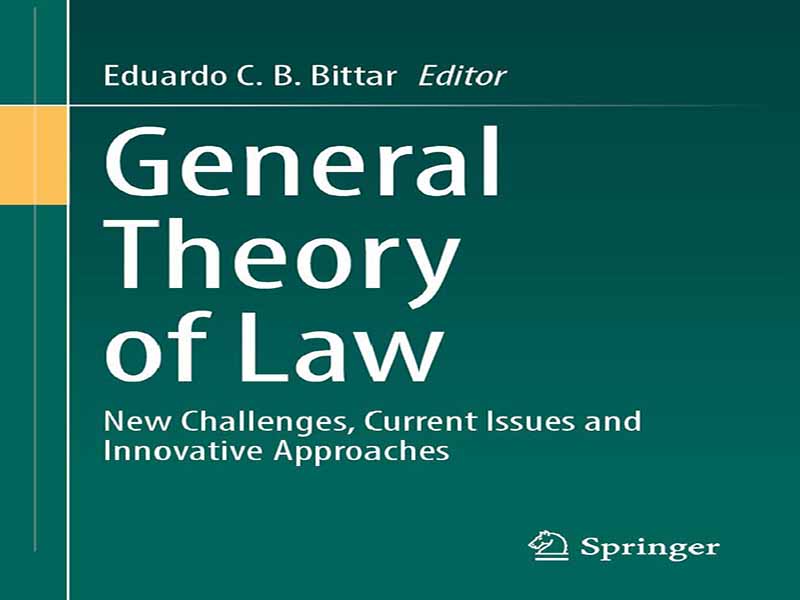
- عنوان کتاب: General Theory of Law -New Challenges, Current Issues and Innovative Approaches
- نویسنده: Eduardo C. B. Bittar
- حوزه: نظریه حقوقی
- سال انتشار: 2026
- تعداد صفحه: 193
- زبان اصلی: انگلیسی
- نوع فایل: pdf
- حجم فایل: 1.75 مگابایت
هدف کتاب «نظریه عمومی حقوق: چالشهای جدید، مسائل جاری و رویکردهای نوآورانه» گرد هم آوردن محققانی است که در مورد چالشهای فعلی پیش روی نظریه عمومی حقوق فکر میکنند. با توجه به تحولات زمان و جامعه، نظریه عمومی حقوق باید در مواجهه با دایرهالمعارف عظیم دانش حقوقی، جایگاه خود را تغییر دهد. گروه عظیمی از چالشهای ناشی از دوران کنونی و پیچیدگی عملکرد سیستمهای اثباتی حقوقی، نظریه عمومی حقوق را با خود به همراه دارد که مستلزم تأمل در مورد نقش، کارکرد، واقعیت و معنای این حوزه از دانش حقوق است. این کتاب را باید اثری در حوزه معرفتشناسی حقوق، نظریه حقوق و علم حقوق دانست، زیرا دانش این حوزهها را در بر میگیرد. هدف کتاب از ابتدا تا انتها با تمرکزی واحد تدوین شده است. با این حال، پژوهشی که در محتوای آن گنجانده شده است، در پی حفظ استقلال ایدههایی است که تولید فکری هر یک از نویسندگان همکار را هدایت میکند و به این اثر، خطی از کار میدهد که به تنوع ایدهها احترام میگذارد و همزیستی جهتگیریهای مختلف را در همان فضای گفتگو و گفتگوی علمی امکانپذیر میسازد. بنابراین، این اثر شامل یک واحد است و به چهار فصل تقسیم شده است که هر فصل توسط نویسندهای متفاوت نوشته شده است و به خواننده اجازه میدهد تا به بازسازی تاریخی، دستهبندیهای مفهومی، نقد نظری، مباحث اخیر و مباحث روششناختی دسترسی پیدا کند. در فصل «پیدایش تاریخی نظریه (عمومی) حقوق و فراتر از آن: خاستگاهها، خودمختاری و روشها»، آنا مارگاریدا سیموئس گودنسیو، خاستگاههای تاریخی نظریه عمومی حقوق را مورد بحث و تحلیل قرار میدهد. او در رویکرد خود، در پی برجسته کردن اهمیت نظریه عمومی حقوق است و آن را در تاریخ مدرن قرار میدهد، با تأکید بر جایگاه آن در میانه تاریخ اندیشه در جهان حقوق. این فصل به درک ارتباط بین ظهور تاریخی آن و جستجوی استقلال عقلانی، در بحبوحه گذار بین ژوسانسگرایی و ژوپوزیتیویسم اختصاص دارد. این فصل به اهمیت نظریه عمومی حقوق در تثبیت علم حقوق میپردازد. همچنین، در پی بحث و تحلیل روش حقوق، مفهوم مدرن حقوق و فرآیند تأیید تاریخی نظریه عمومی حقوق است. در پایان، این فصل علاوه بر درک تاریخی، به توسعه ارزیابی انتقادی از این میراث اختصاص دارد. این فصل همچنین در مباحث پایانی خود، مروری گسترده بر جدیدترین چشمانداز نظریه حقوقی، در کثرتگرایی فعلی آن و مهمترین تحولات مفهومی و نظری-روششناختی آن را به خواننده ارائه میدهد. در فصل «گفتمان فراعلمی نظریه عمومی حقوق: رابطه بین نظریه عمومی و نظریههای خاص»، ادواردو سی. بی. بیتار نظریه عمومی حقوق را از رویکردی گفتمانی مورد بحث و تحلیل قرار میدهد و بر اهمیت سهم متقابل بین نشانهشناسی حقوق و نظریه عمومی حقوق تأکید میکند. در این پرسش، متن به شدت با مشارکتهای آلگیرداس جولین گریماس، پیتر گودریچ، دومینیک مینگنو، ماریا جولیا دوندرو و یرژی وروبلوسکی در ارتباط است. در سراسر تحلیل خود، این فصل به درک رابطه بین نظریه عمومی و نظریههای خاص اختصاص داده شده است که در بستر معاصر ظهور کردهاند و به تدریج جای نظریههای عمومی تخصصهای علم حقوق را میگیرند. این نکته در مرکز تحلیل قرار دارد، تا جایی که مشاهده میشود جهان علمی در حوزه حقوق در حال گسترش است که به معنای افزایش شاخهبندی حوزههای جدید علم حقوق است. در این زمینه از تحولات، این بحث مطرح میشود که آیا نظریه عمومی حقوق در مواجهه با تکثیر نظریههای عمومی تخصصها منسوخ شده و جایگاه گفتمانی خود را از دست داده است یا خیر. در واقع، یک تغییر جایگاه وجود دارد که باید مورد تجزیه و تحلیل و آشکار شدن قرار گیرد، نظریه عمومی حقوق به عنوان یک علم فدرال دانش حقوقی تخصصی. با این کار، نیروی بازتابی و نیروی تصمیمگیرنده در فرآیند تطبیق نظریه عمومی حقوق با چالشهای فعلی، هماهنگی بیشتری را آغاز میکنند. این فصل همچنین به درک ماهیت گفتمانی خاصِ بیان علمی نظریه عمومی حقوق اختصاص دارد و به سمت مطالعه جامع ویژگیهای خاص آن، که عبارتند از (۱.) گزارههای جهانی؛ (۲.) گزارههای انتزاعی؛ (۳.) گزارههای تجربی-تحلیلی؛ (۴.) گزارههای نظری؛ (۵.) گزارههای منطقی و استدلالی؛ (۶.) گزارههای پیچیده؛ (۷.) گزارههای وحدتبخش؛ (۸.) گزارههای عمومی؛ (۹.) گزارههای جدلی؛ و (۱۰.) گزارههای استدلالی، حرکت میکند. علاوه بر این مباحث، این فصل به مسئله افزایش عظیم … نیز میپردازد.
The aim of the book General Theory of Law: New Challenges, Current Issues and Innovative Approaches is to bring together researchers who think about the current challenges facing the General Theory of Law. To the extent of the transformations of time and society, the General Theory of Law must be repositioned, in the face of the immense kaleidoscope of legal knowledge. A huge group of challenges arising from current times and the complexification of the functioning of legal positive systems are posed to the General Theory of Law, which calls for a work of reflection to be installed on the role, function, actuality, and meaning of this area of knowledge of Law. This book should be considered a work of Epistemology of Law, Theory of Law, and Science of Law, because the knowledge of these areas is engaged. The aim of the book develops with a single focus, from start to finish. The research that is integrated into its content, however, seeks to maintain the autonomy of ideas that guides the intellectual production of each of the coauthors, which gives the work a line of work that respects the diversity of ideas and allows for the coexistence of different orientations in the same space of interlocution and scientific dialogue. The work therefore contains a unit and is divided into four chapters, each of which is written by a different author, and allows the reader to access historical reconstruction, conceptual categories, theoretical criticism, recent debates, and methodological discussions. In the chapter The historical genesis of the (General) Theory of Law, and beyond: origins, autonomy and methods, Ana Margarida Simões Gaudêncio discusses and analyses the historical origins of the General Theory of Law. In her approach, she seeks to highlight the significance of the General Theory of Law locating it within modern history, with an emphasis on its position in the middle of the history of thought in the universe of Law. The chapter is dedicated to understanding the connection between its historical emergence and the search for rational autonomy, amidst a context of a transition between Jusnaturalism and Juspositivism. The chapter discusses the importance of the General Theory of Law to the consolidation of the Science of Law. Also, it seeks to discuss and analyse the method of Law, the modern concept of Law, and the process of historical affirmation of the General Theory of Law. At the end, the chapter is dedicated to developing, in addition to historical understanding, a critical evaluation of this legacy. This chapter also offers the reader, in its final topics, a broad overview of the most current panorama of Legal Theory, in its current pluralism, and its most significant conceptual and theoretical-methodological transformations. In the chapter The metascientific discourse of the General Theory of Law: the relationship between General Theory and Special Theories, Eduardo C. B. Bittar discusses and analyses the General Theory of Law from a discursive approach, emphasising the importance of the reciprocal contribution between the Semiotics of Law and the General Theory of Law. In this interpellation, the text dialogues intensely with the contributions of Algirdas Julien Greimas, Peter Goodrich, Dominique Maingueneau, Maria Giulia Dondero, and Jerzy Wroblewski. Throughout its analysis, the chapter is dedicated to understanding the relationship between the General Theory and the Special Theories, which have emerged in the contemporary context, and which, gradually, are taking over the place of the General Theories of Specialities of the Science of Law. This point is placed at the centre of the analysis, insofar as what is observed is that the scientific universe in the field of Law is expanding, which has implied an increase in the branching of new fields of the Science of Law. In this context of transformations, it is debated whether the General Theory of Law is outdated and has lost its discursive place, in the face of the multiplication of the General Theories of Specialities. In fact, there is a repositioning, which needs to be analysed and exposed, of the General Theory of Law as a federative science of specialised legal knowledge. With this, the reflexive force and the resolutive force begin to coordinate more harmoniously, in the process of adapting the General Theory of Law to current challenges. This chapter is also dedicated to understanding the specific discursive nature of the scientific enunciation of the General Theory of Law, descending toward an exhaustive study of its specific qualities, which are (i.) universal statements; (ii.) abstract statements; (iii.) empiricalanalytical statements; (iv.) theoretical statements; (v.) rational and demonstrative statements; (vi.) complex statements; (vii.) unifying statements; (viii.) general statements; (ix.) polemic statements; and (x.) argumentative statements. In addition to these topics, the chapter also deals with the problem of the huge increase in circulation of data in a technodigital age, whose processing makes the task of the jurist-Prometheus the only one qualified to deal with the set of necessary information for the practical work of Law. In dialogue with the work by Ronald Dworkin, the concept of jurist-Prometheus is developed as an imaginary figure, but one that is, at the same time, a response to the contemporary tendency of delegating all knowledge to artificial intelligence (AI). With this, the Science of Law has been threatened by a farewell to reason. It is at this point that elaborating the criticism of technocratic rationality becomes necessary, with a view to valuing the reflexive force of the General Theory of Law, taking back its place, importance, and critical role in the dimensions of the concept of Law and its interconnections with the demands for justice and social emancipation. Throughout the analysis, there is a valuable dialogue with the contributions by Jürgen Habermas and António E. Pérez Luño on this subject. Taking this assessment into account, the aim is to stimulate a resumption of the understanding of the role that the General Theory of Law fulfils in our times, especially considering the tasks of a critical and situated understanding of the General Theory of Law, which is offered by the humanised and interdisciplinary approach of the theoretical model of the Theory of Realistic Humanism. In the chapter ‘New’ questions concerning the experience of the Legal System and the problem of the sources of Law or the place and claims of an internal critical approach: going beyond the possibilities of a General Theory of Law, José Manuel Aroso Linhares seeks to analyse and explore the relationship between two central points of the Theory of Law, on the one hand, the question of the content of Law (the issue of Legal System) as a legal system, and, on the other hand, the question of the sources of Law and its dimension of effective practical-social assimilation. The chapter explores the tension between the ‘normratio’ and the plural theory of sources. To this end, the chapter will have to dedicate itself to dealing with this relationship by a resumption of the theoretical legacy left by Savigny (Gewohnheitsrecht, Gesetzesrecht, Juristenrecht). In addition, the chapter will also explore the debate between Herbert L. A. Hart and Ronald Dworkin, focussing on the analysis of the concept of rule and multiple social sources. Furthermore, the article also questions the role of inclusive positivism and exclusive positivism, to thematise the multidimensionality of the legal system, with an emphasis on the idea of the plurality of the sources of Law. Finally, the chapter will focus on applying the theoretical model developed by A. C. Neves, from which it can derive the relationship between system and sources as one of permanent tension between unity and plurality. The chapter makes a valuable contribution to the search for a re-evaluation of this discussion, as it concludes by establishing an elevated role for Legal Theory, in view of its constant state of creative activity in the face of the dynamics of society. In the chapter Uncertainties and unpredictability of the legal system: the application of law under discussion, Pierre Moor develops the theme of the relationship between Law and the universe of facts, in order to delve into a discussion about the dimension of the application and, with this, the challenges imposed by the insecurity that results from the analysis of the facts. On the one hand, if the legal system seeks legal security, on the other hand, the facts impose a state of insecurity that is continuous for the task of applying the Law. Thus, if the task of judicial analysis necessarily involves the understanding of the facts, this means that the General Theory of Law must be able to work on the way of knowing and appropriating the objects of the world. In this, it relies on the contributions of Semiology, under the influence of Ferdinand de Saussure, to develop well the narrative and argumentative
این کتاب را میتوانید از لینک زیر بصورت رایگان دانلود کنید:
Download: General Theory of Law
















نظرات کاربران