











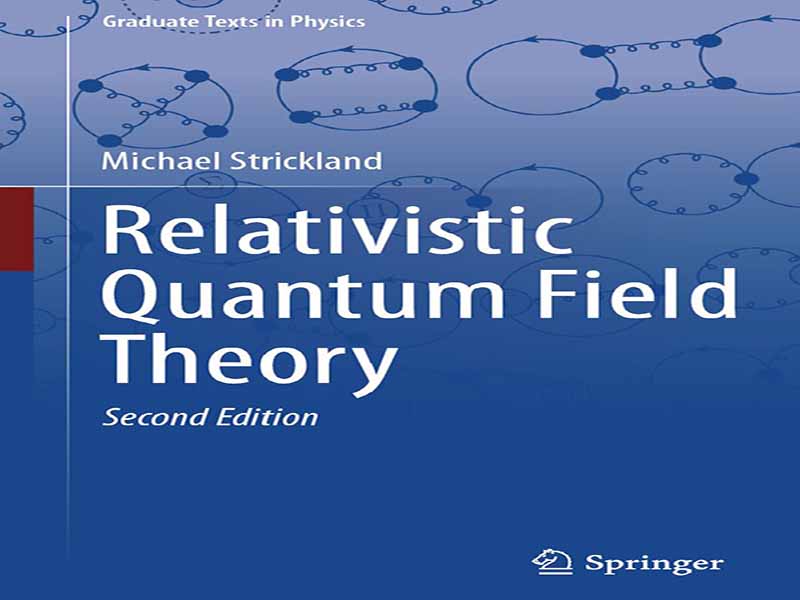
- عنوان کتاب: Relativistic Quantum Field Theory
- نویسنده: Michael Strickland
- حوزه: نظریه کوانتومی
- سال انتشار: 2026
- تعداد صفحه: 473
- زبان اصلی: انگلیسی
- نوع فایل: pdf
- حجم فایل: 9.30 مگابایت
در مکانیک کوانتومی مقدماتی، یاد میگیریم که چگونه یک سیستم را با تعداد ثابتی از ذرات بوزونی یا فرمیونی غیر نسبیتی، کوانتیزه کنیم. از یک فرمالیسم استفاده میکنیم که در آن همیلتونی از یک عدد به یک عملگر ارتقا مییابد و در نتیجه معادله شرودینگر حاصل میشود. خود عملگر همیلتونی به سهم انرژی جنبشی و پتانسیل تجزیه میشود و شکل انرژی پتانسیل معمولاً به عنوان یک ورودی خارجی در نظر گرفته میشود. سپس سوالی مطرح میشود: چگونه میتوان بر اساس اصول اولیه به پتانسیل رسید؟ به عنوان مثال، چگونه (فراتر از آزمایش) میدانیم که پتانسیل کولن پتانسیل مناسب برای ذرات باردار است؟ آیا اصلاحات کوانتومی برای این پتانسیل وجود دارد؟ علاوه بر این، از آنجایی که پتانسیلها به صورت نسبیتی (تعاملات آنی) به خوبی تعریف نشدهاند، چگونه میتوانیم مکانیک کوانتومی را به حالت نسبیتی تعمیم دهیم و علیت را برآورده کنیم؟ در فیزیک کلاسیک، میدانها به منظور ساخت قوانین فیزیکی که علی و محلی هستند، معرفی میشوند. نیروهای کلاسیک که توسط، به عنوان مثال قانون کولن یا گرانش جهانی نیوتن توصیف میشوند، نیاز به کنش از راه دور دارند. در نتیجه، نیرویی که توسط یک جسم احساس میشود، در صورت تغییر موقعیت (یا بار و غیره) جسم دیگر، صرف نظر از فاصله آن جسم، فوراً تغییر میکند. البته، این با آنچه به صورت تجربی مشاهده شده است، مغایرت دارد و از نظر فلسفی نیز نگرانکننده است. در نظریههای میدان کلاسیک ماکسول (میدان الکترومغناطیسی) و انیشتین (میدان گرانشی)، برهمکنشهای بین اجسام توسط میدانی انجام میشود که به صورت محلی عمل میکند و علیت برقرار است. بنابراین به نظر میرسد که از آنجایی که آنها علی و محلی هستند، باید بفهمیم که چگونه نظریههای میدان کلاسیک را کوانتیزه کنیم. یکی دیگر از ناسازگاریها در مکانیک کوانتومی، برخورد تا حدودی تصادفی ما با دوگانگی موج-ذره بود. به عنوان مثال، الکترونها و فوتونها به طور همزمان مانند موج و ذره عمل میکنند و از نظر فیزیکی ویژگیهای مشترک زیادی دارند. هر دو تحت پراش موجمانند از موانع قرار میگیرند، اما میتوانند مانند ذرات گسسته نیز عمل کنند (اثر فوتوالکتریک، پراکندگی کامپتون و غیره). با وجود این، در نظریه کلاسیک، الکترونها به سادگی به عنوان ماده فرض میشوند، در حالی که فوتونها به عنوان موجهایی در میدان الکترومغناطیسی تفسیر میشوند. آیا ممکن است که الکترونها خودشان موجهایی در یک «میدان الکترونی» باشند؟ همانطور که در این کتاب خواهیم آموخت، پاسخ قطعی بله است. به طور کلی، میدان شیء بنیادی است و ذرات مفاهیم مشتق شدهای هستند که تنها پس از کوانتیزه کردن میدان ظاهر میشوند (مثلاً میدان هیگز باعث تولد بوزون هیگز میشود). در مکانیک کوانتومی، ما کمیتهای کلاسیک با مقدار عددی را میگیریم و آنها را به عملگرهایی که در فضای هیلبرت عمل میکنند، ارتقا میدهیم. همانطور که خواهیم دید، حداقل در «کوانتیزه کردن متعارف»، قوانین کوانتیزه کردن یک میدان فقط کمی متفاوت است. درجات آزادی اساسی در نظریه میدان کوانتومی (QFT) توابع عملگر-مقداری از فضا و زمان هستند و از آنجایی که فضا و زمان پیوسته هستند، ما با تعداد نامتناهی از درجات آزادی سروکار داریم، بنابراین باید (دوباره) یاد بگیریم که چگونه با سیستمهایی با تعداد زیادی از درجات آزادی برخورد کنیم (نظریه چندجسمی). پس از اتمام این کار، میتوانیم QFTهایی را که میتوانند در زمینههای مختلف استفاده شوند، به درستی تعریف کنیم، مثلاً نظریه انرژی بالا، ماده چگال، کیهانشناسی و گرانش کوانتومی. فراتر از این، دیراک به ما آموخت که یک نظریه سازگار از الکترونهای نسبیتی مستلزم وجود پادالکترونها (معروف به پوزیترونها) است. در نتیجه، هنگامی که انرژی موجود از دو برابر جرم سکون الکترون E > 2mc2 در فرآیندی به نام تولید جفت فراتر رود، میتوان جفتهای ذره-پادذره ایجاد کرد. و البته، عکس این حالت نیز میتواند اتفاق بیفتد که نابودی جفت نامیده میشود. و میتوان به راحتی هر دو نوع این رویدادها را با استفاده از آشکارسازهای ذرات مدرن مشاهده کرد. نتیجهای که باید از این بگیریم این است که ذرات اشیاء غیرقابل تخریب نیستند. آنها میتوانند ایجاد و نابود شوند و ممکن است فقط برای مدت کوتاهی زنده بمانند. آنها صرفاً برانگیختگیهایی هستند که در یک میدان کوانتومی موج میزنند. اما داستان از این هم خیالیتر است. اگر تولید جفت آستانه انرژی داشته باشد، میتوان استدلال کرد که تا زمانی که انرژیهای موجود از این آستانه (E > 2mc2) تجاوز نکنند، نظریههای غیرنسبیتی خودسازگار خواهند بود. با این حال، در این مرحله اصل عدم قطعیت هایزنبرگ وارد عمل میشود. فرض کنید میخواهیم موقعیت یک ذره را با وضوح فضایی L اندازهگیری کنیم. اصل عدم قطعیت هایزنبرگ به ما میگوید که عدم قطعیت در تکانه Δp ∼> 1/L است. در یک محیط نسبیتی، انرژی و تکانه به هم مرتبط هستند، بنابراین، ما همچنین عدم قطعیتی در انرژی ΔE ∼> 1/L داریم. با این حال، هنگامی که انرژی به علاوه عدم قطعیت آن از E + ΔE > 2mc2 بیشتر شود، میتوان جفتهای ذره-پادذره کاملاً کوانتومی-مکانیکی ایجاد کرد. با برابر قرار دادن این دو، فاصله آستانه L0 = 1/(2m) = λCompton/(4π) را با λCompton = 2π/m به دست میآوریم. از این تمرین، یاد میگیریم که تولید خودبهخودی…
In introductory quantum mechanics, one learns how to quantize a system given a fixed number of non-relativistic bosonic or fermionic particles. One uses a formalism in which the Hamiltonian is promoted from being a number to an operator resulting in the Schrödinger equation. The Hamiltonian operator itself is decomposed into kinetic and potential energy contributions and the potential energy form is typically taken as an external input. A question then arises: how does one arrive at the potential in the first place based on first principles? For example, how do we know (beyond experiment) that the Coulomb potential is the appropriate potential for charged particles? Are there quantum corrections to this potential? In addition, since potentials are not well-defined relativistically (instantaneous interactions), how can we generalize quantum mechanics to the relativistic case and satisfy causality? In classical physics, fields are introduced in order to construct physical laws that are causal and local. Classical forces described by, e.g. Coulomb’s law or Newton’s universal gravitation, require action at a distance. As a result, the force felt by a body changes instantaneously if any other body’s position (or charge, etc.) changes, no matter how far away the other object is. Of course, this is in violation to what is experimentally observed and is also philosophically worrisome. In the classical field theories of Maxwell (electromagnetic field) and Einstein (gravitational field), the interactions between objects are mediated by a field that acts locally and causality is restored. So it seems that, since they are causal and local, we should figure out how to quantize classical field theories. Another inconsistency in quantum mechanics was our somewhat haphazard treatment of wave-particle duality. For example, both electrons and photons act simultaneously like waves and particles and physically they share many common features. They both undergo wavelike diffraction from obstacles, but can also act like discrete particles (photoelectric effect, Compton scattering, etc.). Despite this, in classical theory, electrons are simply postulated to exist as matter, while photons are interpreted as ripples in the electromagnetic field. Is it possible that electrons are themselves ripples in an “electron field”? As we will learn in this book, the answer is a definitive yes. In general, the field is the fundamental object and particles are derived concepts that appear only after quantization of the field (e.g. the Higgs field gives birth to the Higgs boson). In quantum mechanics, we take classical number-valued quantities and promote them to operators acting in a Hilbert space. As we will see, at least in “canonical quantization”, the rules for quantizing a field are only slightly different. The basic degrees of freedom in quantum field theory (QFT) are operator-valued functions of space and time and, since space and time are continuous, we are dealing with an infinite number of degrees of freedom, so we will need to (re-)learn how to deal with systems with a large number of degrees of freedom (many-body theory). Once we are done, we will be able to properly define QFTs that can be used in a variety of different contexts, e.g. high energy theory, condensed matter, cosmology, and quantum gravity. Beyond this, Dirac taught us that a consistent theory of relativistic electrons requires the existence of anti-electrons (aka positrons). As a consequence, it is possible to create particle-antiparticle pairs once the energy available exceeds twice the electron rest mass E > 2mc2 in a process called pair production. And, of course, the reverse can happen, which is called pair annihilation. And one can easily see both of these types of events using modern particle detectors. The conclusion we must draw from this is that particles are not indestructible objects; they can be created and destroyed and may only live for a short amount of time. They are merely excitations surfing on a quantum field. But the story is more fantastical then this. If pair production has an energy threshold, then one could argue that as long as the energies available do not exceed this threshold (E > 2mc2), then nonrelativistic theories would be self-consistent; however, at this point the Heisenberg uncertainty principle comes into play. Let’s say that we wanted to measure the position of a particle with a given spatial resolution L. The Heisenberg uncertainty principle tells us that the uncertainty in the momentum is Δp ∼> 1/L. In a relativistic setting, energy and momentum are connected, therefore, we also have an uncertainty in the energy ΔE ∼> 1/L. However, when the energy plus its uncertainty exceeds E + ΔE > 2mc2, then it is possible create purely quantum-mechanical particle-antiparticle pairs. Equating the two, we obtain a threshold distance L0 = 1/(2m) = λCompton/(4π) with λCompton = 2π/m. From this exercise, we learn that the spontaneous production of particle-antiparticle pairs is important when a particle of mass m is localized in space to a distance which is on order of less than its Compton wavelength. A similar argument holds if one considers localizing particles in time. The energy uncertainty increases as the time interval is made shorter and one eventually turns on the possibility of pair production. The consequence of this is that as one considers shorter and shorter time (or space) intervals one sees more and more particles! Why is this relevant? Since microscopic particles interacting with one another can resolve the other particles’ microscropic dynamics (they behave like observers since they exchange quanta in order to interact), they “see” their partners as being surrounded by an ensemble of particles and antiparticles that _lit in and out of existence. In QFT these ephemeral particles are called virtual particles. The “cloud” of virtual particles that surround particles can modify its observable properties and must be taken into account to consistently understand them.
این کتاب را میتوانید از لینک زیر بصورت رایگان دانلود کنید:
Download: Relativistic Quantum Field Theory























نظرات کاربران