












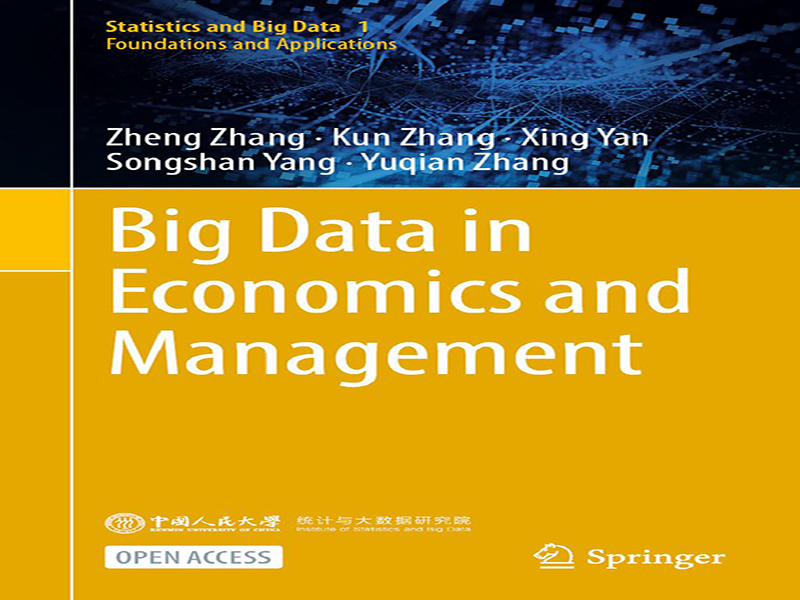
- عنوان کتاب: Big Data in Economics and Management
- نویسنده: Zheng Zhang, Kun Zhang, Xing Yan
- حوزه: کلان داده
- سال انتشار: 2026
- تعداد صفحه: 206
- زبان اصلی: انگلیسی
- نوع فایل: pdf
- حجم فایل: 7.25 مگابایت
بخش اول این مونوگراف بر استنتاج علّی در مطالعات مشاهدهای تمرکز دارد. فصل 1 استنتاج علّی برای یک متغیر درمانی گسسته را آغاز میکند. در چارچوب پیامدهای بالقوه، ابتدا اثرات درمانی متوسط (ATE) یک درمان دوتایی و روشهای شناسایی آن را تحت شرایط عدم اختلاط معرفی میکنیم. برای تخمین ATE، روش وزندهی کالیبراسیون را با بهرهبرداری از ویژگی متعادلسازی متغیرهای کمکی امتیاز تمایل معرفی میکنیم و نشان میدهیم که برآوردگرهای کالیبراسیون سازگار هستند و به حد کارایی نیمهپارامتری میرسند. علاوه بر این، روش یادگیری ماشین نیمهنظارتی را برای تخمین ATE معرفی میکنیم. در نهایت، تخمین اثرات علّی کلی یک متغیر درمانی چند مقداری را بر اساس شبکههای عصبی مصنوعی مورد بحث قرار میدهیم و نشان میدهیم که اگر توابع مزاحم متعلق به یک کلاس همواری مختلط باشند، میتوان «نفرین ابعاد» را کاهش داد. فصل 2 استنتاج علّی را برای یک متغیر درمانی پیوسته گسترش میدهد. ابتدا یک مدل درمانی پیوسته کلی را معرفی میکنیم که طیف گستردهای از پارامترهای علّی مورد علاقه از جمله اثرات درمانی میانگین، چندک و حداقل مربعات نامتقارن را در بر میگیرد. برای این مدل درمان پیوسته عمومی، روش شناسایی را پیشنهاد میکنیم و محدودههای کارایی نیمهپارامتری را تحت شرایط بیمخدوش بودن استخراج میکنیم. سپس یک روش تخمین تعادل متغیر کمکی پیشنهاد میکنیم که محدودههای کارایی نیمهپارامتری عمومی را به دست میآورد. در نهایت، مسائل مختلف آزمون علی پیشرفته را برای یک درمان پیوسته مطالعه میکنیم. فصل 3 مربوط به استنتاج علی برای یک متغیر درمان پیوسته در حضور خطاهای اندازهگیری است. ابتدا تابع دوز-پاسخ متوسط (ADRF) را برای یک درمان آلوده به خطای با مقدار پیوسته توسط یک انتظار شرطی وزندار شناسایی میکنیم. سپس وزنها را به صورت غیرپارامتری با به حداکثر رساندن یک درستنمایی تجربی تعمیمیافته محلی که منوط به مجموعهای در حال گسترش از معادلات گشتاور شرطی است که در هستههای دکانولوشن گنجانده شدهاند، تخمین میزنیم. پس از آن، یک تخمینگر هسته دکانولوشن ADRF میسازیم. بایاس و واریانس مجانبی تخمینگر پیشنهادی را استخراج میکنیم و بسط خطی مجانبی آن را ارائه میدهیم که به انجام استنتاج آماری کمک میکند. برای انتخاب پارامترهای هموارسازی، روش شبیهسازی-برونیابی را اتخاذ میکنیم و یک روش برونیابی جدید برای تثبیت محاسبات پیشنهاد میکنیم.
The first part of this monograph focuses on the causal inference in observational studies. Chapter 1 starts the causal inference for a discrete treatment variable. Within the potential outcomes framework, we first introduce the average treatment effects (ATE) of a binary treatment and its identification methods under the unconfoundedness condition. To estimate the ATE, we introduce the calibration weighting method by exploiting the covariate balancing property of the propensity score and show that the calibration estimators are consistent and attain the semiparametric efficiency bound. Further, we introduce the semi-supervised machine learning method for estimating ATE. Finally, we discuss the estimation of the general causal effects of a multi-valued treatment variable based on the artificial neural networks, and show that the “curse of dimensionality” can be alleviated if nuisance functions belong to a mixed smoothness class. Chapter 2 extends the causal inference for a continuous treatment variable. We first introduce a general continuous treatment model that encompasses a wide variety of causal parameters of interest including average, quantile, and asymmetric least squares treatment effects. For this general continuous treatment model, we propose the identification method and derive the semiparametric efficiency bounds under the unconfoundedness condition. We then propose a covariate balancing estimation method that attains the general semiparametric efficiency bounds. Finally, we study various advanced causal testing problems for a continuous treatment. Chapter 3 concerns the causal inference for a continuous treatment variable in the presence of measurement errors. We first identify the average dose-response function (ADRF) for a continuously valued error contaminated treatment by a weighted conditional expectation. We then estimate the weights nonparametrically by maximizing a local generalized empirical likelihood subject to an expanding set of conditional moment equations incorporated into the deconvolution kernels. Thereafter, we construct a deconvolution kernel estimator of ADRF. We derive the asymptotic bias and variance of the proposed estimator and provide its asymptotic linear expansion, which helps conduct statistical inference. To select our smoothing parameters, we adopt the simulation-extrapolation method and propose a new extrapolation procedure to stabilize the computation.
این کتاب را میتوانید از لینک زیر بصورت رایگان دانلود کنید:
Download: Big Data in Economics and Management

























نظرات کاربران