













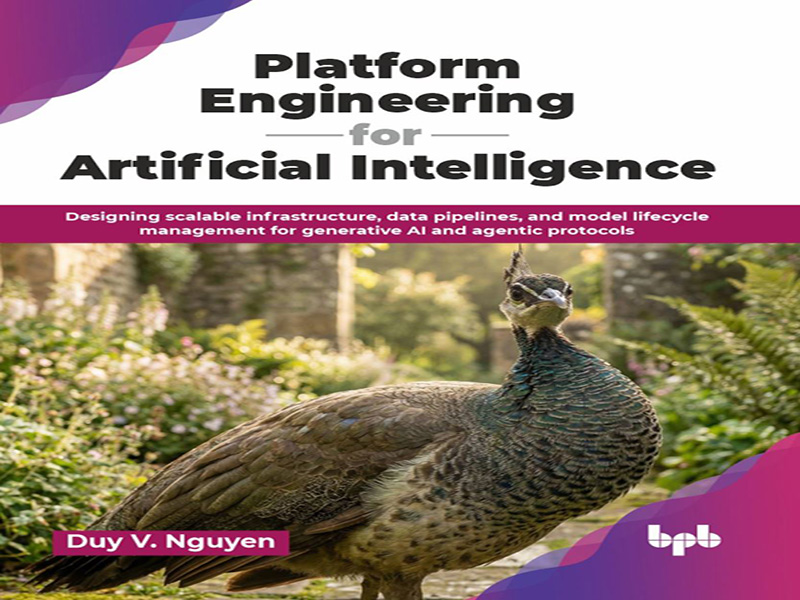
- عنوان کتاب: Platform Engineering for Artificial Intelligence
- نویسنده: Duy V. Nguyen
- حوزه: پلتفورم هوش مصنوعی
- سال انتشار: 2026
- تعداد صفحه: 711
- زبان اصلی: انگلیسی
- نوع فایل: pdf
- حجم فایل: 10.0 مگابایت
این کتاب بدون صبر، تشویق و حمایت بیدریغ خانواده و دوستانم که عمیقاً از آنها سپاسگزارم، ممکن نبود. تشکر صمیمانه من به ویژه از پدر و مادرم (بو ما)، همسرم هوآ، و دخترانم آن و تام است – شما بزرگترین منبع تشویق و قدرت من بودهاید. از انتشارات BPB برای راهنمایی و همکاریشان در به ثمر رساندن این کتاب سپاسگزارم. این یک سفر طولانی از تهیه پیشنویس، اصلاح و پالایش بود که با همکاری داوران با بصیرت، کارشناسان فنی کوشا و ویراستاران فداکار امکانپذیر شد. همچنین میخواهم از مربیان و همکارانی که افتخار همکاری با آنها را در طول ۲۳ سال گذشته در صنعت فناوری، از VietSoftware گرفته تا IBM، Red Hat، LTK و Disney داشتهام، قدردانی کنم. راهنمایی، بازخورد و رفاقت شما، سفر حرفهای من را به شیوههای عمیقی شکل داده است. تشکر ویژه از ونکی رائو، دیوید جارامیلو، بیل بودین، دیوید برد، تام کریمر، باب دیل، محمد الرفاعی، جاش تراوینسکی، آلیس سالیوان، برایان گودمن، اریک ونگر، ساچین ویاس، های لی و سان تران که راهنماییها و تشویقهایشان تأثیر ماندگاری بر رشد من داشته است. در نهایت، از هر خوانندهای که این کتاب را انتخاب کرده است: متشکرم. کنجکاوی، اشتیاق و حمایت شما همان چیزی است که این کار را معنادار میکند. امیدوارم این کتاب شما را برای ساخت پلتفرمهای فردا توانمند سازد. مقدمه مهندسی پلتفرم با فناوری شروع نمیشود. اغلب با اصطکاک شروع میشود. لحظهای که سعی میکنید یادگیری ماشین را از یک نوتبوک به تولید، از یک نسخه آزمایشی اثبات مفهوم به یک نتیجه تجاری واقعی ببرید، متوجه میشوید که چقدر داربست از دست رفته است. خطوط لوله به دلیل مقیاس از هم میپاشند. مدلها رانش میکنند: قراردادهای داده در بهترین حالت یک توافق دست به دست هستند. چیزی که برای یک تیم کارساز بود، وقتی توسط ده تیم دوباره استفاده شود، به یک مسئولیت تبدیل میشود. با این حال، تقاضا برای مهندسی هوش مصنوعی همچنان در حال افزایش است. تکرار سریعتر، انطباق سختگیرانهتر، مدلهای بیشتر، کاربران بیشتر، فشار هزینه بیشتر. راهحل فقط ابزارهای بیشتر نیست. بلکه یک پلتفرم است: یک بنیان منسجم، قابل اعتماد و توسعهپذیر که پیچیدگی تصادفی ساخت، استقرار و بهرهبرداری از سیستمهای هوش مصنوعی در مقیاس بزرگ را کاهش میدهد. این کتاب در مورد ساختن آن بنیان است. این کتاب نوید یک طرح کلی جهانی را نمیدهد. در عوض، مجموعهای از الگوهای بادوام، اصول راهنما و بدهبستانهای عملی برگرفته از محیطهای آشفته، توزیعشده و پرمحدودیتی که پلتفرمهای واقعی در آنها فعالیت میکنند را ارائه میدهد. شما یاد خواهید گرفت که چگونه سیستمهایی را طراحی کنید که بدون از کار افتادن، تغییر را جذب کنند، فقط سطح کافی را برای توانمندسازی کاربران در اختیار داشته باشند و حتی با رشد آنها قابل کنترل باقی بمانند. اگر تا به حال وظیفه داشتهاید که هوش مصنوعی را در یک سازمان واقعی، در مقیاس بزرگ، به کار بگیرید و مجبور بودهاید نحوه اتصال دادهها، مدلها، تیمها و اعتماد را بفهمید، این کتاب برای شماست. فصل 1: نیاز به مهندسی پلتفرم در هوش مصنوعی – این فصل با توضیح اینکه چرا رویکردهای سنتی به توسعه هوش مصنوعی در مقیاس بزرگ از کار میافتند و چگونه مهندسی پلتفرم یک بنیان مشترک و تکرارپذیر برای پشتیبانی از سیستمهای هوش مصنوعی مقیاسپذیر، کارآمد و پایدار در سراسر سازمانها فراهم میکند، پایه و اساس کتاب را بنا میکند. فصل 2: مفاهیم اصلی پلتفرمهای هوش مصنوعی – این فصل تعریف میکند که چه چیزی پلتفرمهای هوش مصنوعی را از سیستمهای نرمافزاری سنتی متمایز میکند. این فصل اجزای اصلی مانند خطوط لوله داده، گردشهای کاری مدل و لایههای هماهنگسازی را معرفی میکند و بر ماهیت دادهمحور و چرخه عمر محور توسعه هوش مصنوعی تأکید دارد. این فصل نشان میدهد که چگونه حاکمیت، اتوماسیون و مقیاسپذیری در ستون فقرات پلتفرم تعبیه شدهاند تا از بارهای کاری در حال تحول هوش مصنوعی پشتیبانی کنند. فصل 3: تدوین برنامه برای خطوط لوله داده – این فصل بر اهمیت برنامهریزی قبل از ساخت خطوط لوله داده، پایهگذاری معماری در اهداف واقعی کسبوکار به جای مهندسی واکنشی تأکید میکند. این فصل به بررسی چگونگی تعریف اهداف قابل اندازهگیری، ارزیابی حجم و سرعت دادهها، همسو کردن نیازهای ذینفعان و انتخاب ابزارهای مناسب میپردازد و پایهای برای خطوط لوله مقیاسپذیر و کارآمد ایجاد میکند که میتوانند با تکامل بارهای کاری هوش مصنوعی شما سازگار شوند. فصل 4: معماری خطوط لوله داده – این فصل برنامهریزی را به معماری تبدیل میکند و نشان میدهد که چگونه خطوط لولهای را طراحی کنید که مدولار، قابل مشاهده و انعطافپذیر در موارد استفاده دستهای و بلادرنگ باشند. این فصل، بدهبستانهای بین حالتهای پردازش را بررسی میکند، نقش کیفیت دادهها و مقیاسپذیری را تقویت میکند و ابزارهای رایج را بررسی میکند. یک مطالعه موردی در دنیای واقعی نشان میدهد که چگونه تصمیمات طراحی و اصول پلتفرم برای ارائه خطوط لوله با کیفیت بالا و مقیاسپذیر همگرا میشوند. فصل 5: ساخت خطوط لوله یادگیری ماشین ماژولار – این فصل نحوه حرکت از آزمایشهای یکباره به گردشهای کاری یادگیری ماشین سرتاسری مقیاسپذیر را مشخص میکند. این فصل اصول طراحی ماژولار را معرفی میکند که ساختار و قابلیت اطمینان را به چرخه عمر یادگیری ماشین میآورد. این فصل به ابزارها و چارچوبهای رایج میپردازد و این ایدهها را در یک مطالعه موردی در دنیای واقعی در مورد پیشبینی تقاضا پایهگذاری میکند و نشان میدهد که چگونه خطوط لوله یادگیری ماشین ماژولار، سیستمهای هوش مصنوعی مقیاسپذیر را فعال میکنند. فصل 6: حاکمیت و امنیت در پلتفرمهای هوش مصنوعی – این فصل، انطباق و کنترل را در … ادغام میکند.
This book would not have been possible without the patience, encouragement, and unwavering support of my family and friends, to whom I am profoundly grateful. My heartfelt thanks go especially to my parents (Bố mẹ), my wife Hoa, and my daughters An and Tâm—you have been my greatest source of encouragement and strength. I am grateful to BPB Publications for their guidance and partnership in bringing this book to life. This was a long journey of drafting, revising, and refining, made possible by the collaboration of insightful reviewers, diligent technical experts, and dedicated editors. I would also like to acknowledge the mentors and colleagues I have had the privilege of working with over the past 23 years across the tech industry, from VietSoftware to IBM, Red Hat, LTK, and Disney. Your mentorship, feedback, and camaraderie have shaped my professional journey in profound ways. Special thanks to Venky Rao, David Jaramillo, Bill Bodin, David Byrd, Tom Creamer, Bob Dill, Mohamed El-refai, Josh Travinski, Alyse Sullivan, Brian Goodman, Eric Wenger, Sachin Vyas, Hai Le, and Son Tran, whose guidance and encouragement have had a lasting impact on my growth. Finally, to every reader who picked up this book: thank you. Your curiosity, passion, and support are what make this work meaningful. I hope this book empowers you to build the platforms of tomorrow. Preface Platform engineering does not start with technology. It often starts with friction. The moment you try to take machine learning from a notebook to production, from a proof of concept demo to a real business outcome, you discover how much scaffolding is missing. Pipelines break under scale. Models drift: Data contracts are a handshake agreement at best. What worked for one team becomes a liability when reused by ten. Yet, the demand for AI engineering keeps growing. Faster iteration, stricter compliance, more models, more users, more cost pressure. The solution is not just more tools. It is a platform: a coherent, reliable, and extensible foundation that reduces the accidental complexity of building, deploying, and operating AI systems at scale. This book is about building that foundation. It does not promise a universal blueprint. Instead, it offers a set of durable patterns, guiding principles, and practical trade-offs drawn from the messy, distributed, and constraint-heavy environments in which real platforms operate. You will learn how to design systems that absorb change without breaking, expose just enough surface area to empower users, and remain governable even as they grow. If you have ever been tasked with making AI work in a real organization, at scale, and had to figure out how to wire up data, models, teams, and trust, then this book is for you. Chapter 1: Need for Platform Engineering in AI – This chapter sets the foundation for the book by explaining why traditional approaches to AI development break down at scale and how platform engineering provides a shared, repeatable foundation to support scalable, efficient, and sustainable AI systems across organizations. Chapter 2: Core Concepts of AI Platforms – This chapter defines what makes AI platforms distinct from traditional software systems. It introduces core components like data pipelines, model workflows, and orchestration layers, emphasizing the data-centric and lifecycle-driven nature of AI development. The chapter highlights how governance, automation, and scalability are built into the platform’s spine to support evolving AI workloads. Chapter 3: Developing Plan for Data Pipelines – This chapter emphasizes the importance of planning before building data pipelines, grounding architecture in real business objectives rather than reactive engineering. It walks through how to define measurable goals, assess data volume and velocity, align stakeholder needs, and select the right tools, setting a foundation for scalable, performant pipelines that can adapt as your AI workloads evolve. Chapter 4: Architecting Data Pipelines – This chapter translates planning into architecture, showing how to design pipelines that are modular, observable, and resilient across batch and real-time use cases. It explores the trade-offs between processing modes, reinforces the role of data quality and scalability, and examines common tooling. A real-world case study illustrates how design decisions and platform principles converge to deliver high-quality, scalable pipelines. Chapter 5: Building Modular Machine Learning Pipelines – This chapter establishes how to move from one-off experiments to scalable endto- end ML workflows. It introduces modular design principles, that bring structure and reliability to the ML lifecycle. The chapter walks through common tools and frameworks, and grounds these ideas in a real-world case study on demand forecasting, showing how modular ML pipelines enable scalable AI systems. Chapter 6: Governance and Security in AI Platforms – This chapter integrates compliance and control into fast-moving ML workflows. It introduces platform-level patterns like access control, audit trails, secrets management, and bias checks, showing how governance becomes a firstclass feature. A case study illustrates how trust and velocity can coexist. Chapter 7: Infrastructure as Code for AI Platforms – This chapter codifies the platform foundation with repeatable, auditable infrastructure. It shows how treating compute, storage, networks, and policy as code brings consistency to AI workloads, from provisioning compute fleets to enforcing least-privilege access. Through tools like Terraform and Kubernetes, this chapter builds a pattern library for infrastructure modules and closes with a case study on deploying a high-throughput video analytics stack using IaC. Chapter 8: Financial Management in Platform Engineering – This chapter brings cost accountability into AI platforms by integrating FinOps into engineering workflows. It shows how to track, allocate, and optimize resource usage through tagging, dashboards, and policy-aware IaC. AI teams learn to treat cost per model as a measurable, optimizable metric embedded into the platform lifecycle. Chapter 9: Operationalizing Machine Learning Models – This chapter turns models into durable services. It explores batch, online, streaming, and edge deployment patterns, then digs into packaging, scaling, and routing techniques. Readers learn to monitor drift, automate retraining, and apply rollout strategies. Operational excellence is framed as a platform contract balancing accuracy, latency, and cost across the model lifecycle. Chapter 10: Observability and Monitoring – This chapter discusses how modern AI platforms must be observable by design. It reframes monitoring from basic uptime checks to continuous, integrated feedback across infrastructure, data, and models. The chapter explores instrumentation techniques, anomaly detection, and unified telemetry pipelines, culminating in a real-world use case that shows how proactive observability drives resilient, explainable, and cost-aware AI systems. Chapter 11: Building High-performing Platform Teams – This chapter frames team composition as a core platform decision. Successful AI platforms rely on diverse, product-minded teams, united by a shared mission: to make AI delivery fast, safe, and scalable. This chapter outlines key roles, structural patterns, and collaboration practices that keep platform teams connected, responsive, and impactful. Chapter 12: Managing and Scaling Platform Teams — This chapter codifies the shift from individual excellence to operational maturity. As the AI platform expands, success hinges on scalable workflows, adaptive agile practices, and a tooling stack that aligns a globally distributed team. This chapter explores intake systems, cadence tuning, and collaboration infrastructure that help platform teams deliver consistently, uphold standards, and remain tightly connected to evolving product needs. Chapter 13: Scaling Platforms for Enterprise AI — This chapter charts how platform engineering absorbs the complexity of scaling AI across products, regions, and regulatory lines. It presents a workload-aware blueprint to support elastic training, inference, and data flows using a mix of cloud-native, hybrid, and edge infrastructure. Chapter 14: Platform Engineering for Generative AI — This chapter applies platform thinking to the emerging demands of generative workloads, shifting focus from prediction to creation. It presents a thin global control plane and regional compute planes as a scalable foundation for training, fine-tuning, and inference of large models, integrating governance, FinOps, and safety as code. From LLM infrastructure and costaware optimization to agentic workflows and retrieval-augmented generation, this chapter equips teams to operationalize GenAI capabilities with speed, control, and enterprise trust. Chapter 15: Real-world Use Cases — This chapter distills architectural judgment by tracing platform design under real-world pressure. Through case studies in personalization, healthcare analytics, and content moderation, it reveals how common AI workloads reshape the platform under constraints of scale, compliance, and latency. Each solution shows how platform principles manifest as reusable artifacts. These patterns become a blueprint for new AI products, without starting from scratch. Chapter 16: Emerging Trends in AI Platforms — This chapter discusses how tomorrow’s AI platforms are reshaping themselves into systems that not only run models but reason, adapt, and enforce values. Ethical AI becomes infrastructure with policy encoded in pipelines. Agentic platforms learn from signals and automate control. Semantic, graph-native foundations elevate meaning as the new interface. What emerges is not a smarter backend, but a platform that understands, governs, evolves, and reflects on its own role in the loop.
این کتاب را میتوانید از لینک زیر بصورت رایگان دانلود کنید:
























نظرات کاربران