














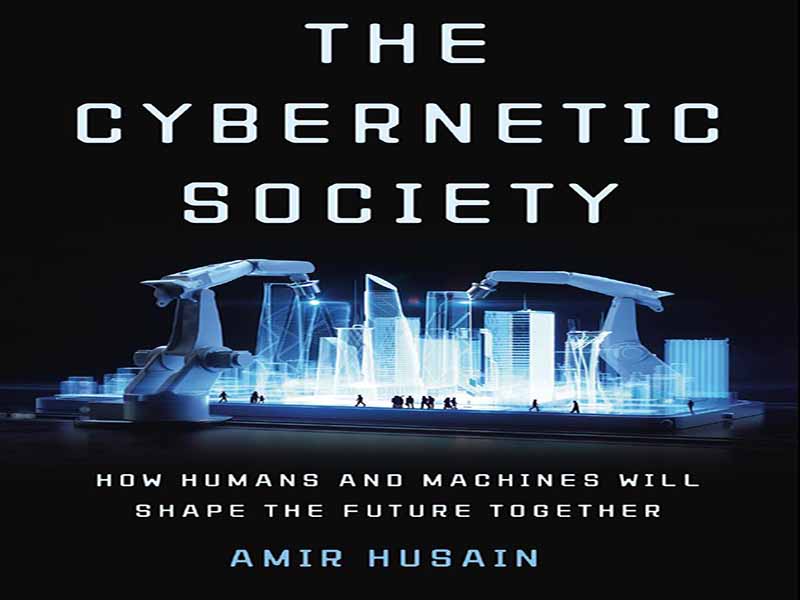
- عنوان کتاب: The Cybernetic Society How Humans and Machines Will Shape the Future Together
- نویسنده: Amir Husain
- حوزه: سایبرنتیک
- سال انتشار: 2025
- تعداد صفحه: 212
- زبان اصلی: انگلیسی
- نوع فایل: pdf
- حجم فایل: 2.75 مگابایت
من یک تکنسین، برنامهنویس و کارآفرین هستم. من تمام عمرم با کامپیوتر و فناوری کار کردهام. شرکت هوش مصنوعی که من در سال ۲۰۱۳ به عنوان تنها بنیانگذار آن تأسیس کردم، در زمان مدیرعاملی من به ارزش ۱.۴ میلیارد دلار رسید. در سال ۲۰۱۸ با یکی از بزرگترین شرکتهای هوافضای جهان برای راهاندازی یک کسبوکار دیگر همکاری کردم: اولین شرکت هوش مصنوعی که بر ادغام میلیونها هواپیمای خودران در فضای هوایی تجاری تمرکز داشت. من با دهها ژنرال چهار و سه ستاره، دریاسالار و رهبر غیرنظامی در سراسر دولت همکاری کردهام تا ایدهها و فناوریهایی را که آینده را شکل میدهند، تصور، تصور و توسعه دهم. از من خواسته شده است که بسیاری از رهبران دولتی در کشورهای سراسر اروپا، آسیا و خاورمیانه و همچنین هیئت مدیره برخی از بزرگترین شرکتهای جهانی را توجیه کنم. در نهایت، من در هیئت مدیره دانشکده علوم کامپیوتر دانشگاه تگزاس در آستین، یکی از ده دانشکده برتر علوم کامپیوتر در کشور، خدمت کردهام. همه اینها به این معنی است که تحقیقات فناوری، پیادهسازی، سیاستگذاری و پیامدهای آینده نوآوری، بیشتر چیزهایی هستند که من دهههاست در آنها غرق شدهام. در سال ۲۰۱۵، قبل از اینکه «جنون» هوش مصنوعی به جریان اصلی تبدیل شود، شروع به نوشتن کتاب «ماشین هوشمند» کردم که به بررسی کارهایی که ما به عنوان انسان در عصر هوش مصنوعی عمومی انجام میدهیم، میپردازد. در آن زمان بسیار دور به نظر میرسید، اما اکنون نه چندان. با این حال، همه اینها در گذشته است. آیندهای که من پیش رو میبینم، در عین حال، خیالیتر و در عین حال محتملتر از هر چیزی است که در گذشته تصور میکردم. و این آینده همان چیزی است که این کتاب در مورد آن است. کد، آگاهی و کنترل سه ساختار اساسی آینده هستند. از آنجا که ما غرق در دستگاهها و وبسایتها هستیم، همه ما قدرت نرمافزار را دیدهایم. توانایی کد در تبدیل یک دانشجوی انصرافی دکترا به یک مولتیمیلیونر، یکی از جنبههای این قدرت است. جنبه دیگر، توانایی آن در سوق دادن یک شرکت به اوج بازار و پیشی گرفتن از بانکها، شرکتهای نفتی و شرکتهای بزرگ است. کد به غیرمادی کردن چیزهایی که زمانی فیزیکی و ملموس بودند به ساختارهای دیجیتال و اثیری کمک کرده است. وقتی مارک اندریسن، سرمایهگذار کهنهکار، در مورد «نرمافزار در حال بلعیدن جهان» صحبت میکند، او به سادگی چیزی را توصیف میکند که باید تا الان برای همه ما آشکار شده باشد. برای مثال، به یک وسیله نقلیه الکتریکی نگاه کنید. این وسیله نقلیه اجزای مکانیکی پیچیدهای مانند پیستونها، سوپاپها، کاربراتورها، سیمها و اهرمهای شتابدهنده، شمعها، فیلترهای هوا، فیلترهای روغن و موارد دیگر را با یک سیستم کنترل دیجیتال، موتورهای الکتریکی و باتری جایگزین میکند. بسیاری از پیچیدگیهای مکانیکی و قطعات فیزیکی واقعی به سادگی “خورده میشوند”. و این کد است که این بلعیدن را انجام میدهد. و آنچه برای ماشین اتفاق میافتد، برای جهان اتفاق میافتد. غیرمادیسازی. اشیاء با نرمافزار جایگزین میشوند. کد یک بلوک سازنده اساسی و اساسی دنیای مدرن است. اما چه چیزی میتوانید با آن بسازید؟ البته، میتوانید صفحات گسترده، برنامههای ایمیل و وبسایت بسازید. اما معلوم میشود که قابل توجهترین چیزی که میتوانید با کد تغییر دهید، تکامل دهید و شاید حتی بسازید، آگاهی است. و منظورم فقط این نیست که هوش مصنوعی ساختاری از کد باشد و در نهایت هوش مصنوعی به آگاهی برسد. منظورم این است که تقویت انسان و تقویت آنچه که از قبل آگاه است به وسیله ابزارهای دیجیتال. از کدی که در تریلیونها دستگاه تعبیه شده است که همه برای تأثیرگذاری بر آگاهی انسان گرد هم میآیند. منظورم از هر نظر قابل تصور است، و برخی از مواردی که هنوز نمیتوانیم تصور کنیم. و در نهایت، کد میتواند برای کنترل استفاده شود. البته، ما میدانیم که حتی دستگاههای سادهای مانند ترموستاتها میتوانند یک سیستم خنککننده را کنترل کنند. یک شبکه پیچیده از حسگرها که در یک فرآیند تولید مواد شیمیایی پیادهسازی میشوند، میتوانند ماشینها، دماها، جریانها و بسیاری موارد دیگر را در کف تولید کنترل کنند. اما کد همچنین برای کنترل افراد استفاده میشود. از آن برای شکلدهی و تأثیرگذاری بر افکار، تغییر دیدگاهها و برنامهریزی مجدد ذهنها در مقیاس وسیع استفاده میشود. از نظر انتقادی، مقیاسی که میتواند به این هدف دست یابد، محدود به یک فرد یا یک گروه نیست، بلکه در سطح کل جوامع است. آیا کد، آگاهی و کنترل، همه در یک سطح هستند؟ پاسخ من به این سوال شخصی است، تحت تأثیر تجربیات خودم و در غیاب اثبات وجود، نظر ذهنی من است. من معتقدم کد مهمترین این سه پدیده است. و بله، من کد را یک پدیده مینامم زیرا میتواند به تنهایی در یک سیستم پیچیده تکامل یابد. گذشته از همه اینها، DNA در بوته آزمایش پیچیده سیارهای چهار میلیارد ساله تکامل یافته است که خود محصول جهانی سیزده میلیارد ساله است. شاید بتوان چنین فرآیند زمانبری را ناکارآمد نامید؛ شاید با نگاهی به نمونههای انسانی بسیاری که پیشرفتهترین تجلی این تکامل هستند، حتی بتوان آن را ناقص نامید. اما این یک پدیده است. به عنوان مثال، در نظر بگیرید که چگونه کد ژنتیکی یک موجود تک سلولی ساده به کد عصبی پیچیدهای که شناخت انسان را کنترل میکند، تکامل یافته است. به لطف ریاضیدان بریتانیایی آلن تورینگ، اکنون میدانیم چیزی به نام جهانشمولی محاسباتی وجود دارد. به عبارت دیگر، ماشینها، زیرلایهها و دستگاههایی با طرحهای مختلف و ساخته شده از مواد کاملاً متفاوت، همگی میتوانند در توانایی خود برای … معادل باشند.
I am a technologist, programmer, and entrepreneur. I’ve worked with computers and technology my entire life. The AI company I started in 2013 as its sole founder achieved a $1.4B valuation while I was CEO. In 2018 I partnered with one of the largest aerospace companies in the world to launch another business: the first AI company focused on integrating millions of autonomous aircraft into commercial airspace. I’ve worked with dozens of four- and three-star generals, admirals, and civilian leaders across government to imagine, conceive, and develop ideas and technologies that will shape the future. I’ve been asked to brief many government leaders in countries across Europe, Asia, and the Middle East, as well as the boards of some of the largest global companies. Finally, I’ve served on the board of the UT Austin Department of Computer Science, one of the top ten CS schools in the nation. All of this is to say that technology research, implementation, policy, and the future implications of innovation are most of what I have been immersed in for decades. In 2015, before the AI “craze” was mainstream, I began writing The Sentient Machine, which explores what we as humans would do in the age of artificial general intelligence. It seemed quite far then, but not so much now. Yet all of this is in the past. The future I see ahead is, at once, more fantastical and yet more likely than anything I have imagined in the past. And that future is what this book is about. Code, consciousness, and control are three elemental constructs of the future. Because we’re awash in devices and websites, we’ve all seen the power of software. The ability of code to turn a PhD dropout into a multimillionaire is one aspect of this power. Another is its ability to propel a company to the very top of a market, outpacing banks, oil companies, and conglomerates. Code has helped dematerialize things that were once physical and tangible into digital, ethereal constructs. When veteran investor Marc Andreessen talks about “software eating the world,” he is simply describing what should by now be evident to us all. Look at an electric vehicle, for instance. It replaces complex mechanical components such as pistons, valves, carburetors, accelerator wires and levers, spark plugs, air filters, oil filters, and much more with a digital control system, electric motors, and a battery. A lot of mechanical complexity and actual physical parts are simply “eaten up.” And it’s the code that’s doing the eating up. And what’s happening to the car is happening to the world. Dematerialization. Objects replaced with software. Code is a fundamental, elemental building block of the modern world. But what can you build with it? Of course, you can build spreadsheets, email applications, and websites. But it turns out that the most remarkable thing you can change, evolve, and perhaps even build with code is consciousness. And I don’t just mean this in the sense of AI being a construct of code and AI eventually becoming conscious. I mean this in the sense of human augmentation and the enhancement by digital means of that which is already conscious. Of code embedded in trillions of devices that all come together to influence human consciousness. I mean it in every sense imaginable, and some we can’t yet imagine. And finally, code can be used to control. Of course, we know that even simple devices like thermostats can control a cooling system. A complex web of sensors implemented in a chemical-manufacturing process can control machines, temperatures, flows, and much else on the production floor. But code is also used to control people. It is used to shape and influence thought, shift views, and reprogram minds at a massive scale. Critically, the scale at which it can achieve this is not limited to an individual or a group but is at the level of entire societies. Are code, consciousness, and control all on equal footing? My answer to this question is personal, colored by my own experiences and, in the absence of an existence proof, my subjective opinion. I believe code to be the most important of these three phenomena. And yes, I call code a phenomenon because it can evolve on its own in a complex system. After all, DNA evolved in the complex crucible of a four-billion-year-old planet, itself a product of a thirteen-billion-year-old universe. Perhaps one can call such a time-consuming process inefficient; perhaps, looking at many human specimens who are the most advanced manifestation of this evolution, one can even call it imperfect. But a phenomenon it is. Consider, for instance, how the genetic code of a simple single-celled organism has evolved into the complex neural code that governs human cognition. Thanks to the British mathematician Alan Turing, we now know there is a thing called computational universality. In other words, machines, substrates, and devices of various designs and made from entirely different materials can all be equivalent in their ability to solve any solvable problem. They may differ in how long they take, how large they are, or the resources they consume, but theoretically they are all equivalent. For example, a modern supercomputer and a Commodore 64 from 1982 are both capable of performing the same calculations—the difference lies in efficiency and scale, not in fundamental capability. My corollary, then, is that code can take root in any number of underlying systems capable of performing computation. To the extent that code, when manifested in the world as more than an idea, is an internal organization of the computing system on which it runs, code along with the physical mechanism that executes it can be thought of as a particular organization of matter. This concept bridges the gap between the abstract nature of code and its physical manifestation, much like how our thoughts (abstract) are ultimately the result of neuronal firing patterns (physical). Any system that runs long enough and can mutate and transmogrify matter is likely to give birth to computational machines. The useful ones are those in which useful code is present as an organization of the underlying matter on which it runs. Everything else is secondary. This principle applies not just to silicon-based computers but potentially to any system capable of information processing—from quantum computers to theoretical biological computers. If we abstract away all the physical aspects of such systems, better and faster ways to create code mean better and faster results, one of which is consciousness, and another is control. If indeed we can create intelligence that is an existential proof of the emergence of consciousness and control as products of code, it would finally prove the deep, fundamental connection among these three concepts. Just as genetic code gave rise to biological consciousness and neural configurations enable our control over our bodies, perhaps more potent configurations of code will lead to new paradigms of consciousness and control that we can scarcely imagine today. Be that as it may, in order to understand the world of the future, one must understand code, consciousness, and control. But with what lens should we view all of this? What organizing mental models and principles of integration should we apply to synthesize so much that is happening across finance, technology, military, and foreign affairs to build a holistic picture of the world of the future? The best answers I have been able to produce are shared with you in this book. The organizing principle we use to tie all these diverse ideas together is cybernetics, the study of control and communication in complex systems. As you read ahead, you will come across Geoffrey West’s scaling laws, which are well-known and studied in biology, in urban planning, and in the context of organizations. But here you will also see these laws applied in the context of mental amplification. You’ll read about Peter Turchin’s ideas on cliodynamics and elite overproduction in context of the technological shifts they can drive. And you’ll journey with me as we tour future technology-enabled metropolises such as Neom and imagine the future of our cybernetic world. The strangely futuristic sounding field of cybernetics was conceived by MIT professor and polymath Norbert Wiener in the 1930s. Wiener had been born into and lived in a world that was rapidly industrializing. He recognized that automation meant that the relationship between humans and machines would evolve significantly. So, rather than continuing to view humans and machines as separate entities, he proposed that we humans begin to consider ourselves and our machines as a unified whole. Such a perspective has the advantage of encompassing the collaboration between humans and machines, where their behavior and performance become composites of biology, computation, and mechatronics. In a 1948 paper, Wiener and his colleagues defined cybernetics as “the scientific study of control and communication in the animal and the machine.” This broad definition allowed cybernetics to encompass fields as diverse as engineering, biology, psychology, and sociology. Over the ensuing seventy-five years, we’ve seen waves of enthusiasm for cybernetics, focusing on everything from technology to social and philosophical concerns. Now we find ourselves entering an era in which automation, sensorization, and synthetic intelligence pervade every aspect of the physical world. Cybernetics no longer applies solely to operators and machines but also extends to understanding the future of politics, economics, sociology, and militaries. These emergent systems result from the interaction among humans, machines, code repositories, and synthetic nervous systems. In this new reality, many worry about unemployment and humans displaced by machines, but it may be more beneficial for everyone to understand the nuanced field of cybernetics and how it will likely affect the coming decades. The scale of this interaction is staggering. The International Data Corporation (IDC) estimates that by 2025, the amount of data generated annually will reach 175 zettabytes. This equates to over 20 terabytes of data per person on Earth every year. We are our decisions and knowledge, but we are also increasingly the data that devices gather on our behalf and the actions that machines execute for us. Consider the smartphone in your pocket. It’s not merely a communication device or a consumer electronic; it’s also an extension of your mind, memory, and body. It knows your location, your habits, your social connections, and often your most intimate thoughts. This cybernetic augmentation of our capabilities is precisely what Wiener envisioned when he coined the term cybernetics: the seamless integration of human and machine. This may sound futuristic, fantastical, or simply unreal. However, even just talking about it makes it real. Reflexivity, as introduced by George Soros in his book The Alchemy of Finance, reveals that thinking and behaving as if something is true can make it true. Soros demonstrated this principle in financial markets, showing how investors’ perceptions can influence market fundamentals, which in turn reinforce those perceptions. When machines join humans in holding assumptions and acting upon them, the potential for materializing those assumptions becomes a fascinating phenomenon. The types of autonomous and semiautonomous systems we are now building form beliefs and make assumptions based on observation, and they usually involve an opaque decision-making process through a neural network to execute an action. This leads us to explore whether billions of machines believing in an outcome and acting accordingly can make that outcome a fait accompli. And this can happen in areas as small as an individual athlete or musician’s career and also in vast scopes such as the outcome of an election and the choice of specific representatives who make it into Parliament. Today, the visual performance of athletes is already being studied by computer vision systems that break down specific responses, styles of play, and many more aspects of performance for which we humans don’t even have a name. Based on all this observation, machines can already provide an idea of which athlete is likely to do better in a particular situation. Picking this athlete over another and even how much to pay them are decisions that are already and will continue to be guided by algorithms. And although I don’t know of any mega-donor now who is using artificial intelligence to determine which of a panoply of candidates to back in an election in order to pursue their political and business aims, I would be surprised if this too isn’t happening already. So cybernetic systems are affecting us today, and the quantum of their effect will only continue to increase. Just as it makes sense to understand how your body works so you can make smart choices about your health, it’s crucial to understand the technology that will shape us so we can make smart choices about our cybernetic selves. The Apple-ification of technology has made it so that complex, powerful devices seem to be oversimplified appliances. But these systems and the software they run are not mere appliances; they are integral parts of our extended cognitive apparatus. To stay relevant and maintain control over our lives in the cybernetic age, we must push beyond the notion of technology as black-box appliances and strive for a deeper understanding and mastery of these tools that have become extensions of ourselves. If we don’t, well, then the machines will likely imagine a future for us and make it real. The concept of reflexivity in financial markets has been empirically studied by many, including Zhong and associates of the Zhejiang University of Finance and Economics in Hangzhou, China. Their research, published in Physica A: Statistical Mechanics and Its Applications, suggests that reflexive feedback loops between market prices and underlying economic fundamentals can indeed lead to self-fulfilling prophecies. By incorporating market impact and momentum traders into an agent-based model, they investigate the conditions for the occurrence of self-reinforcing feedback loops and the coevolutionary mechanism of prices and strategies. Their study found that when individual trades don’t significantly affect market prices (low market impact), traders who follow market trends don’t cause large price swings. However, they disturb the balance between those who follow trends and those who go against them. This leads to more people adopting trend-following strategies, creating a self-reinforcing cycle where trends become stronger simply because more people are following them. On the other hand, when individual trades have a big impact on prices (high market impact), these trend-following traders cause larger price fluctuations. In this scenario, smart traders start to avoid following the trends, leading to a negative feedback loop in which trend following becomes less attractive. These findings underscore how the behavior of traders in financial markets can amplify trends and create feedback loops that influence market outcomes. This kind of self-reinforcing or self-correcting behavior doesn’t just happen in finance; we can see similar patterns in many other areas of life as well. For example, LLMs (large language models) are widely used today to write news articles. The choice of words they use to fill in details or provide explanations is critical. Is the organization Hamas a group of freedom fighters? Are they Palestinian separatists? Are they a “proxy group”? Are they terrorists? Whatever the LLM believes makes it into an article that, when read by millions, transforms a machine belief into a human belief—or, at the very least, strongly influences human beliefs. As AI systems become more integrated into decision-making processes across various domains, keeping an eye on all the other areas where these reflexive dynamics emerge will be nothing short of fascinating. The interaction between AI-driven decision-making and market behaviors could lead to new forms of self-reinforcing feedback loops, making this an area ripe for further exploration. Could the very knowledge that an AI agent can create such feedback loops allow it to evolve strategies that seek to deliberately create such loops? For example, if a machine knows that the bestseller or “Editor’s Choice” list it publishes influences purchases, and it is running out of an inventory of the truly popular products, does it “fake” a bestseller to create demand by including an abundantly stocked product on the list? I would hazard a guess that many AI-driven systems seeking to optimize a goal such as yield or profit do similar things already. And if it happens in trading and e-commerce, can it also happen in politics? In fashion? In any area of society where trend followers and trend rejectors share the psychology of the traders Zhong and colleagues studied? Could algorithms then discover ways in which a goal can be achieved if they believe the goal can be achieved by creating the right feedback loops? Imagine that. A reality that emerges because machines believe in an outcome. If this is about to be so, then a new digital age now dawns with consequences so deep and profound that nothing we have read or experienced could have prepared us for what is to come. Many commentators are worried about how many jobs AI might eliminate and whether new jobs will materialize. Already we’ve seen live customer support replaced with chatbots. We’ve seen content writers replaced by generative AI. We’ve seen fast-food chains install robotic kiosks. Our smoothies and drinks are now being delivered by robots. I recently even had a robot live-manufacture highly customized fragrances for my mother and my wife at Dubai’s fantastic Museum of the Future. But the transition we are undergoing will have consequences far more profound than changes in the statistics around human employment. We are moving from a world of some physical mystery into a pervasive, sensorized landscape—a reality that is predicted, analyzed, computed, and most likely influenced by large-scale socio-technological cybernetic systems. The implications of this paradigm shift will reshape not just the way we perceive our world but also how we interact with it and, fundamentally, who holds power within it. A 2019 study by the Brookings Institution estimated that 36 million American workers, or about 25 percent of the US workforce, face high exposure to automation in the coming decades. However, the same study also highlighted that this technological shift will likely create new job opportunities, particularly in sectors that require uniquely human skills such as creativity, empathy, and complex problem-solving. What effect will be dominant? It is too early to tell.
این کتاب را میتوانید از لینک زیر بصورت رایگان دانلود کنید:
Download: The Cybernetic Society How Humans and Machines Will Shape the Future Together






















نظرات کاربران