












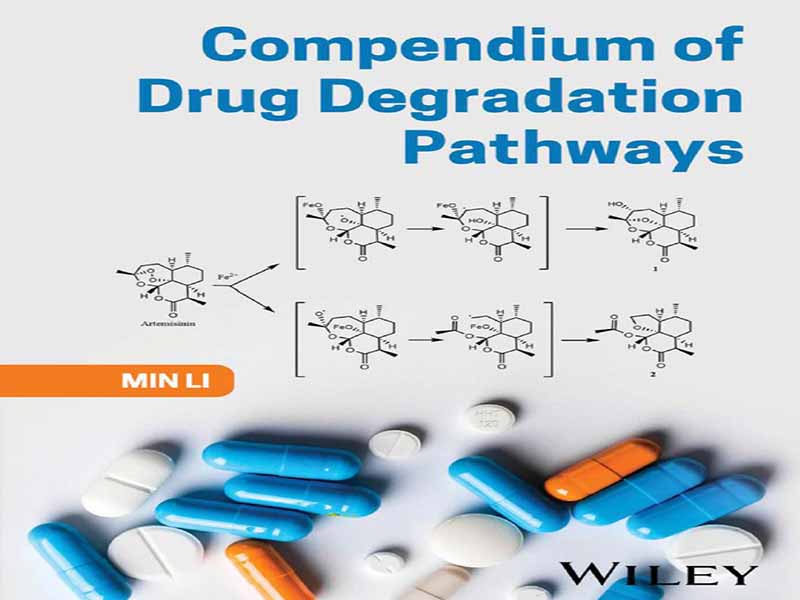
- عنوان کتاب: Compendium of Drug Degradation Pathways
- نویسنده: Min Li
- حوزه: دارو سازی
- سال انتشار: 2026
- تعداد صفحه: 636
- زبان اصلی: انگلیسی
- نوع فایل: pdf
- حجم فایل: 4.75 مگابایت
اولین کتاب من، شیمی آلی تجزیه دارو، در سپتامبر ۲۰۱۲ منتشر شد و قرار بود خلاصهای سیستماتیک از شیمی تجزیه دارو بر اساس انواع مسیرهای تجزیه مانند تجزیه هیدرولیتیک، اکسیداتیو و فتوشیمیایی باشد. هر نوع تجزیه دارو که در یک فصل خاص از آن کتاب مورد بحث قرار گرفته است، با نمونههایی از مسیر(های) تجزیه خاص یک دارو یا داروهای مرتبط با موضوع فصل اثبات شده است. از این رو، برای مولکولهای دارویی که در آن مثالها مورد بحث قرار گرفتهاند، هیچ خلاصه یا مجموعهای از تمام مسیرهای تجزیه شناخته شده یا گزارش شده آنها وجود ندارد. به عبارت دیگر، قرار نبود شیمی تجزیه یک داروی خاص به طور کامل در آن کتاب ارائه شود. اگرچه شیمی آلی تجزیه دارو میتواند به عنوان یک کتاب درسی برای دانشجویان تحصیلات تکمیلی رشته علوم دارویی یا هر کسی که به مطالعه سیستماتیک شیمی تجزیه دارو علاقهمند است، مورد استفاده قرار گیرد، اما به ذهنم خطور کرده است که در بسیاری از موارد، دانشمندان شاغل، به ویژه کسانی که در صنعت داروسازی کار میکنند، نیز دوست دارند یک کتاب مرجع مناسب داشته باشند که در آن شیمی تجزیه بسیاری از داروهای تجویز شده رایج به راحتی یافت شود. از این رو، در طول حدود ۱۰ سال گذشته، هدف من این بوده است که با خلاصه کردن مسیرهای تخریب شناخته شده یا گزارش شده داروهای مولکول کوچک نمونه در کتاب دیگری، این نیاز را برآورده کنم، زیرا چنین کتابی مکمل شیمی آلی تجزیه دارو از دیدگاهی متفاوت خواهد بود. علاوه بر این، چنین کتابی میتواند مکمل فارماکوپههای رسمی نیز باشد، که در آنها شیمی تخریب داروها معمولاً گنجانده نمیشود، با وجود این واقعیت که مکمل کاملاً محدود خواهد بود. در طول بررسی محتوای چنین کتابی، تصمیم گرفتم تقریباً ۳۰۰ داروی مولکول کوچک نمونه را انتخاب کنم و سپس مسیرهای تخریب آنها را در مونوگرافهای مربوطه که به ترتیب حروف الفبا از نامهای ژنریک این داروها مرتب شدهاند، خلاصه کنم. انتخاب این داروهای نمونه در کتاب بر اساس چندین عامل زیر بود: تعداد نسخههای تجویزی آنها، وضعیت فروش و قرار گرفتن در فهرست داروهای ضروری سازمان بهداشت جهانی (داروهایی که طبق تعریف سازمان بهداشت جهانی “نیازهای مراقبتهای بهداشتی اولویتدار جمعیت را برآورده میکنند”. بسیاری از داروها در دستههای درمانی یکسان، ساختارهای اصلی و گروههای عاملی یکسان یا مشابهی دارند و بنابراین مسیرهای تخریب یکسان یا مشابهی نیز خواهند داشت. به همین دلیل، این داروها معمولاً در مونوگرافهای مربوطه پوشش داده میشوند و شناختهشدهترین یا پرکاربردترین داروها به عنوان ورودیهای اصلی مونوگرافها قرار میگیرند. چنین نمونههایی شامل مونوگراف بنزودیازپینها، مونوگراف امپرازول و آزولهای مرتبط، مونوگراف اوپیوئیدها و مونوگراف پنیسیلینها میشود، اما محدود به این موارد نیست. قبل از مونوگرافها، بدنه اصلی کتاب فعلی «خلاصهای از مسیرهای تخریب دارو»، یک فصل کلی با عنوان «مقدمه» گنجانده شده است که در آن مروری مختصر بر دیدگاه نظارتی در مورد پایداری دارو و ناخالصیها و همچنین مروری بر شیمی تخریب دارو ارائه شده است. علاوه بر این، نقش و محدودیت آزمایش استرس، که اغلب به عنوان مطالعه تخریب اجباری نیز شناخته میشود، نیز مورد بحث قرار گرفته است. در مونوگرافهای بعدی، هر مونوگراف با ساختار(های) مولکول(های) دارو و گردآوری اطلاعات کلیدی آنها، از جمله نامهای شیمیایی، نامهای تجاری، فرمولها، نسبتهای جرم-بار اضافی مونوایزوتوپی پروتونه شده، وزنهای مولکولی متوسط و اعداد CAS، در صورت لزوم، آغاز میشود. اطلاعات فوق عمدتاً از منابع عمومی زیر گرفته شده است: Pubchem (pubchem.ncbi.nlm.nih.gov)، ویکیپدیا (wikipedia.org)، Drugbank آنلاین (go.drugbank.com)، BMRB (بانک دادههای رزونانس مغناطیسی زیستی، https://bmrb.io/metabolomics/mol_mass.php) و Chemspider (chemspider.com). در بدنه اصلی هر مونوگراف، شیمی تخریب شناخته شده یا گزارش شده یک دارو یا داروها به صورت متنی خلاصه شده است که با ارائه شماتیک مسیر(های) تخریب دارو دنبال میشود. اغلب، شیمی تخریب گزارش شده یک دارو بر اساس مطالعات استرس یا تخریب اجباری دارو بوده است. همانطور که در مقدمه این کتاب بحث شده است، شیمی تجزیه پیشبینیشده از مطالعات تجزیه اجباری ممکن است لزوماً نشاندهنده شیمی تجزیه مشاهدهشده در شرایط نگهداری طولانیمدت نباشد، یعنی شیمی تجزیه مشاهدهشده در شرایط پایداری توصیهشده توسط شورای بینالمللی هماهنگسازی الزامات فنی برای ثبت داروهای مورد استفاده انسان (ICH) و سازمان بهداشت جهانی (WHO). کیفیت پیشبینی شیمی تجزیه در شرایط واقعی به درک روشنی از اصول شیمی تجزیه دارو متکی است، به طوری که مطالعه تجزیه اجباری تحت شرایطی انجام میشود که مرتبط هستند.
My first book, Organic Chemistry of Drug Degradation, was published in September 2012, and it was intended to be a systematic summary of drug degradation chemistry based on the types of degradation pathways such as hydrolytic, oxidative, and photochemical degradation. Each type of drug degradation discussed in a particular chapter of that book is substantiated by examples of the specific degradation pathway(s) of a drug or drugs related to the subject of the chapter. Hence, for the drug molecules discussed in those examples, there are no summary or compilation of all of their known or reported degradation pathways. In other words, the degradation chemistry of a particular drug was not intended to be presented in its entirety in that book. Although Organic Chemistry of Drug Degradation can be used as a textbook for graduate students majoring in pharmaceutical sciences or anyone who is interested in a systematic study of drug degradation chemistry, it has occurred to me that in many occasions the practicing scientists, particularly those working in the pharmaceutical industry, would also like to have a convenient reference book in which the degradation chemistry of many commonly prescribed drugs can be readily found. Hence, for the past 10 years or so, it has been my goal to try to fulfill that need by summarizing the known or reported degradation pathways of representative small molecule drugs in another book, as such a book would be complementary to Organic Chemistry of Drug Degradation from a different perspective. Furthermore, such a book might also be supplementary to official pharmacopeias, where the degradation chemistry of drugs is usually not included, despite the fact that the supplementation would be quite limited. During the course of pondering the contents of such a book, I decided to choose approximately 300+ representative small molecule drugs and then to summarize their degradation pathways in respective monographs that are organized in alphabetical order of the generic names of these drugs. The selection of these representative drugs in the book was based upon the following several factors: the numbers of their prescription, sales status, and inclusion in WHO List of Essential Medicines (the ones that “satisfy the priority health care needs of the population” per World Health Organization’s definition). Many drugs in the same therapeutic categories share the same or similar core structures and functional groups and thus would have the same or similar degradation pathways. For this reason, these drugs are typically covered in the same respective monographs, with the best known or most widely used drugs as the main entries of the monographs. Such examples include, but not limited to, the monograph for benzodiazepines, the monograph for omeprazole and related azoles, the monograph for opioids, and the monograph for penicillins. Preceding the monographs, the main body of the current book Compendium of Drug Degradation Pathways, a general chapter entitled “Introduction” is included, in which a brief overview of the regulatory perspective on drug stability and impurities, as well as an overview of drug degradation chemistry is provided. In addition, the role and limitation of stress testing, often referred to as forced degradation study as well, is also discussed. In the ensuing monographs, each one is started with the structure(s) of the drug molecule(s), and compilation of their key information, including chemical names, brand names, formulas, protonated monoisotopic mass- over- charge ratios, average molecular weights, and CAS numbers, as applicable. The above information is mostly derived from the following publicly accessible resources: Pubchem (pubchem.ncbi.nlm.nih.gov), Wikipedia (wikipedia. org), Drugbank online (go.drugbank.com), BMRB (Biological Magnetic Resonance Data Bank, https://bmrb.io/metabolomics/mol_mass.php), and Chemspider (chemspider.com). In the main body of each monograph, the known or reported degradation chemistry of a drug or drugs is summarized in text, which is followed by schematic presentation of the drug degradation pathway(s). Quite often, the reported degradation chemistry of a drug was based upon stress or forced degradation studies of the drug. As it is discussed in Introduction of this book, the degradation chemistry predicted from the forced degradation studies may not necessarily represent the one under real- life scenario, i.e., the degradation chemistry observed under the long- term storage conditions as represented by the stability conditions recommended by the International Council on Harmonisation of Technical Requirements for Registration of Pharmaceuticals for Human Use (ICH) and the World Health Organization (WHO). The quality for the prediction of real- life degradation chemistry relies upon a clear understanding of the principles of drug degradation chemistry, so that the forced degradation study would be conducted under the conditions that are relevant to the drug degradation in real- life scenarios. The degradation pathways obtained by utilizing these conditions, sometimes referred to as purposefully designed conditions or mechanism- based conditions, would most likely to contain the real- life degradation profiles. In other words, the real- life degradation pathways of a drug would more likely be a subset of its degradation pathways obtained under the forced degradation conditions purposefully designed by taking into consideration of the perceived degradation mechanisms and kinetics. To borrow the terms from the quality- by- design paradigm, the degradation pathways of a drug obtained under the purposefully designed forced degradation conditions would be the design space, while the real- life degradation pathways would be the control space, a subset of the design space. Due to the limitation that many forced degradation studies reported in the literature were not necessarily performed under purposefully designed conditions, readers are cautioned in places where artificial degradation may occur in these forced degradation studies. To facilitate organization of the book contents, the alphabetically arranged monographs are further sequentially grouped into eight sections, following Section 1, Dedication and Preface, and Section 2, Introduction. It has been quite a long time since my initiation for the writing of this book, which far exceeds the originally proposed timeline for the completion; this is primarily due to the change of my career path and increasing responsibilities, particularly during the last 10 years at Huahai Pharmaceutical Co., Ltd. For this reason, I sincerely apologize for the delay, while being very grateful for the patience of the editors of Wiley. Meantime, I am also very appreciative for the opportunities provided by Huahai that allowed me to create Center of Excellence for Modern Analytical Technologies (CEMAT), the analytical core group within Huahai that is dedicated to investigating and solving the most technically challenging problems occurring in the stages of pharmaceutical research and development, scale up, regulatory filing, and commercial production. CEMAT was modeled after my former organizations at Merck & Co., Inc. (Department of Regulatory and Analytical Sciences–Analytical, or RAS- A), Schering- Plough Corp. (Department of Global Quality Services– Analytical Sciences, or GQS- AS), and Merck again (Analytical Chemistry in Development and Supply–Supply Analytical Sciences, or ACDS- SAS). CEMAT was formally established in early 2016, and it currently has a staff of approximately 150 scientists and is equipped with state- of- art analytical instrument and equipment. Over the years, members of CEMAT have performed thousands of investigations, many of which are related to elucidating drug degradation pathways and mechanisms. The results obtained from these investigations have further expanded my own knowledge in drug degradation chemistry. Among the many young and energetic scientists who have made significant contributions toward the establishment, operation, and continuous improvement of CEMAT, I would like to extend my special gratitude to Mr. Wenquan Zhu, who helped me from the very beginning for the establishment, organization, daily operation, as well as future expansion of CEMAT. My appreciation also goes to the following CEMAT members, some of whom have moved on to other career opportunities: Mr. Wenbin Chen, Dr. Jinsheng Lin, Mr. Jian Ye, Mr. Jianyang Jin, Dr. Lewei Zheng, Ms. Dan Li, Dr. Jichao Wang, Dr. Jian Ma, Mr. Wenping Hu, Ms. Qianqian Lv, Mr. Zijian Kuang, Mr. Shaolan Wang, Mr. Zijian Wang, Mr. Qiang Zhou, Ms. Hong Cai, and Ms. Qiaohong Guo. Between June 2020 and May 2023, I was also responsible for managing Shanghai Synergy Pharmaceutical Sciences, the Huahai subsidiary dedicated to small molecule innovative drug research. During that three- year tenure, my team advanced two novel drug candidates into clinical stage and developed several preclinical drug candidates. Toward these achievements, I am very much indebted to the following team members at Shanghai Synergy: Dr. Yu Huang, Dr. Jia Chen, Dr. Chengjun Deng, Dr. Xin Xu, Dr. Zhan Cai, and Dr. Zhezhou Yang. Over the past 10 years or so, I also have had the opportunities to work with many capable and hard- working colleagues at different functional areas of Huahai and its subsidiaries. Their expertise, contributions, and friendship have made my journey of the last 10 years more fruitful and enjoyable. Among them, the most notable ones are Mr. Jun Du, Ms. Linda (Lihong) Lin, Dr. Xiaodi Guo, and Mr. Jay (Jie) Wang. Jun was the founder and CEO of Huahai US and also a longtime friend of mine for 20 years, who not only introduced me to Huahai but also gave me firm support and trust throughout the time we had worked together. Linda and her Regulatory Affairs team have worked closely with my CEMAT team on a great number of projects, particularly during their regulatory filing stages. Together, we have overcome many challenges in dealing with pharmaceutical impurities in terms of their assessment, control strategies, analytical methods, and specifications. Xiaodi and his formulation team performed formulation development for HHT- 120, a novel orally available anticoagulant developed by my teams initially at Huahai US and later at Shanghai Synergy. HHT- 120 demonstrated comparable antithrombotic efficacy but significantly less bleeding risk as compared to an approved drug in animal models. Jay, a congenial colleague often with a sense of subtle humor, was a vice president for Huahai’s API Sales Department. In 2016, I worked with him to help resolve analytical issues associated with a key API product for a major client, during which process I introduced the first liquid chromatography – triple quadruple mass spectrometer into Huahai to ensure the method for a trace impurity with sufficient sensitivity, specificity, and robustness. My special thanks go to the editors of Wiley for their excellent job in the production of this book, in addition to their patience. Last but not the least, my profound gratitude goes to my family, especially my wife Beihong, for her love, support, and unwavering confidence in me for more than 30 years.
این کتاب را میتوانید از لینک زیر بصورت رایگان دانلود کنید:
Download: Compendium of Drug Degradation Pathways






















نظرات کاربران