









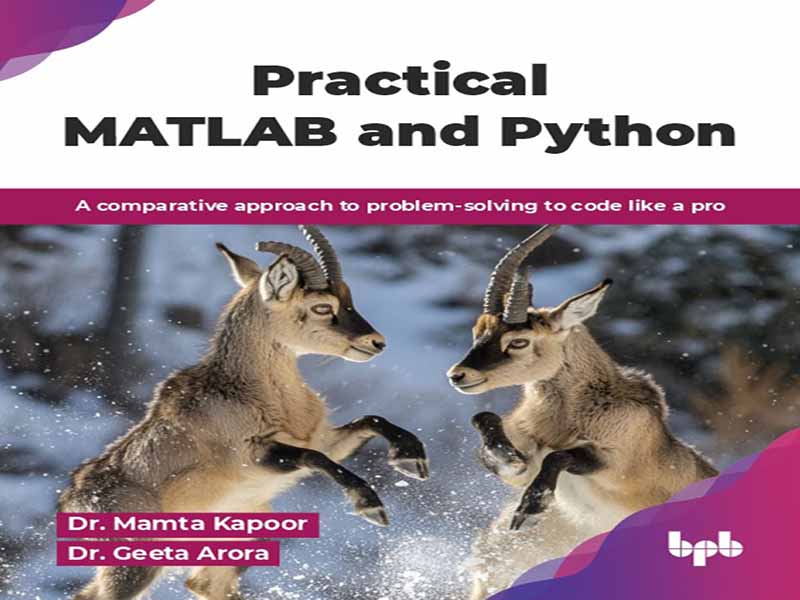
- عنوان کتاب: Practical MATLAB and Python
- نویسنده: Dr. Mamta Kapoor
- حوزه: برنامهنویسی پایتون, برنامهنویسی متلب
- سال انتشار: 2026
- تعداد صفحه: 540
- زبان اصلی: انگلیسی
- نوع فایل: pdf
- حجم فایل: 8.20 مگابایت
نوشتن کد کارآمد و ساختاریافته به عنوان یک مهارت ضروری در حوزههای مختلف مانند مهندسی، محاسبات علمی، تجزیه و تحلیل دادهها، علوم داده، یادگیری ماشین، مدلسازی ریاضی و زمینههای تحقیقاتی ظهور کرده است. در میان ابزارهای متعدد موجود، MATLAB و پایتون به عنوان دو زبان برنامهنویسی پرکاربرد شناخته میشوند که هر کدام نقاط قوت و کاربردهای خاص خود را دارند. این کتاب برای ایجاد درک مشترک از این دو زبان در بین خوانندگان تهیه شده است. این کتاب یک راهنمای یادگیری و همچنین یک مرجع عملی برای دانشجویان، مربیان، محققان، تحلیلگران داده، دانشمندان داده و متخصصانی که مایل به کسب مهارت در این دو زبان و همچنین افزایش مهارتهای کدنویسی خود هستند، ارائه میدهد. این کتاب با مفاهیم اولیه شروع میکند و طیف گستردهای از موضوعات، از جمله متغیرها، انواع داده، ساختارهای کنترل، توابع، مدیریت دادهها، ترسیم و موضوعات پیشرفته مانند پردازش سیگنال و تصویر را پوشش میدهد. هر فصل قابلیتهای کلیدی MATLAB و پایتون را با مثالهای مقایسهای ارائه میدهد. این مقایسه در کنار هم به خوانندگان کمک میکند تا تفاوتهای نحوی، شباهتهای مفهومی و نقاط قوت متمایز را شناسایی کنند. برنامههای کاربردی و تمرینهای عملی در دنیای واقعی برای تقویت فرآیند یادگیری و پر کردن شکاف بین تئوری و عمل گنجانده شده است. چه شما یک مبتدی باشید که در حال کاوش در حوزه برنامهنویسی در حوزههای علمی هستید و چه یک متخصص باتجربه، این کتاب برای افزایش مهارتهای کدنویسی و حل مسئله شما طراحی شده است. در پایان این سفر، خوانندگان توانایی انتخابهای مناسب در انتخاب ابزار و بهکارگیری مهارتهای کدنویسی خود را در حوزههای مختلف، از جمله تجزیه و تحلیل دادهها، علوم داده، محاسبات علمی و غیره، به دست خواهند آورد. فصل 1: مقدمهای بر MATLAB و پایتون – این فصل مقدمهای اساسی بر زبانهای MATLAB و پایتون ارائه میدهد. در پایان این فصل، شما درک درستی از تفاوتها و نقاط قوت کلیدی MATLAB و پایتون خواهید داشت. علاوه بر این، یاد خواهید گرفت که چگونه محیطهای برنامهنویسی مربوطه را راهاندازی و پیمایش کنید. جدا از این، با عملیات اساسی، ساختارهای داده و توابع در هر دو زبان آشنا خواهید شد. فصل 2: متغیرها و انواع داده در MATLAB و پایتون – توضیح کاملی از متغیرها و انواع داده در MATLAB و پایتون، به ترتیب در این فصل ارائه شده است. این فصل موضوعات مختلفی را پوشش میدهد، از جمله نحوه تعریف متغیرها در MATLAB، نحوه استفاده از آرایهها و ماتریسها در MATLAB و نحوه استفاده از رشتهها و ساختارها در MATLAB. چندین موضوع در رابطه با پایتون معرفی میشوند، مانند تعریف متغیرها، انواع دادهها و رشتهها، لیستها، تاپلها، دیکشنریها و مجموعهها. علاوه بر این، مقایسهای از پایتون و MATLAB از طریق تعدادی مثال ارائه شده است. میتوانید با انجام تکالیف در انتهای فصل، مباحثی را که آنها آموختهاند تمرین کنید. فصل 3: عملیات اساسی در زبانهای MATLAB و پایتون – در این فصل توابع و عملیات اساسی دو زبان برنامهنویسی قوی – پایتون و MATLAB – را بررسی خواهیم کرد. مهندسان و دانشمندان MATLAB را به دلیل مهارت شناخته شدهاش در محاسبات عددی، به ویژه در عملیات حسابی و ماتریسی دوست دارند. ما بررسی خواهیم کرد که چقدر خوب میتواند عملیات منطقی، دستکاریهای پیچیده ماتریس و عملیات حسابی اساسی را اجرا کند – که همه آنها برای تجزیه و تحلیل دادهها و ایجاد الگوریتم بسیار مهم هستند. با این حال، پایتون که به دلیل سهولت استفاده و سازگاریاش شناخته شده است، طیف گستردهای از ویژگیها، مانند عملیات لیست، دستکاری رشتهها، عملیات حسابی و چندین تابع داخلی دارد که آن را برای پردازش دادهها و برنامهنویسی عمومی مناسب میکند. با درک این ایدههای اساسی در پایتون و متلب، خوانندگان دانش عمیقی از این مفهوم به دست خواهند آورد. فصل 4: جریان کنترل و ساختارها در متلب و پایتون – ایدههای اساسی جریان کنترل و ساختارها در متلب و پایتون، دو زبان برنامهنویسی محبوب در تجزیه و تحلیل دادهها، مهندسی و محاسبات علمی، در این فصل پوشش داده خواهد شد. خوانندگانی که جریان کنترل را درک میکنند، میتوانند برنامههای مؤثرتری بنویسند که بتوانند وظایف را تکرار کنند و تحت شرایط خاص قضاوت کنند. این فصل به سه بخش اصلی سازماندهی شده است که دو بخش اول به ترتیب بر زبانهای پایتون و متلب تمرکز دارند، در حالی که بخش سوم به نمونههای محبوب هر یک میپردازد. شما حلقهها و عبارات شرطی را در بخش متلب مطالعه خواهید کرد. میتوانید ایدههای مرتبط را در بخش پایتون بررسی کنید، اما با برخی تغییرات نحوی. پایتون منطق تصمیمگیری را از طریق عبارات شرطی پیادهسازی میکند. فصل 5: توابع و اسکریپتها در MATLAB و پایتون – در این فصل یاد خواهید گرفت که چگونه توابع و اسکریپتها را در MATLAB و پایتون، دو زبان برنامهنویسی قوی که اغلب در تجزیه و تحلیل دادهها و محاسبات علمی استفاده میشوند، ایجاد و استفاده کنید. نحوه استفاده از کلمه کلیدی function در MATLAB برای تعریف توابع قابل استفاده مجدد در di را کشف خواهید کرد.
Writing efficient and structured code has emerged as an essential skill across different domains such as engineering, scientific computing, data analysis, data science, machine learning, mathematical modeling, and research fields. Among several tools available, MATLAB and Python are noted as the two widely adopted programming languages, each with its own strengths and applications. This book is created to develop a common understanding of these two languages among readers. It provides a learning guide as well as a practical reference for the students, educators, researchers, data analysts, data scientists, and professionals who wish to gain proficiency in these two languages and to enhance their coding skills as well. Initiating with the basic concepts, this book covers a wide range of topics, including variables, data types, control structures, functions, data handling, plotting, and advanced topics such as signal and image processing. Each chapter provides the key functionalities in MATLAB and Python with comparative examples. This side-by-side comparison will help readers identify the syntax differences, conceptual similarities, and distinct strengths. Real-world applications and practice exercises are incorporated to reinforce the learning process and to bridge the gap between theory and practice. Whether you are a beginner who is exploring the programming scope in scientific domains or an experienced professional, this book is designed to enhance your coding and problem-solving skills. By the end of this journey, readers will gain the ability to make suitable choices in tool selection and apply their coding skills in different domains, including data analysis, data science, scientific computing, etc. Chapter 1: Introduction to MATLAB and Python- This chapter provides a basic introduction to the languages MATLAB and Python. By the end of this chapter, you will have an understanding of the key differences and strengths of MATLAB and Python. Moreover, you will learn how to set up and navigate the respective programming environments. Apart from this, you will gain familiarity with fundamental operations, data structures, and functions in both languages. Chapter 2: MATLAB and Python Variables and Data Types- A thorough explanation of the variables and data types in MATLAB and Python, is given this chapter, respectively. This chapter covers a number of topics, including how to define variables in MATLAB, how to use arrays and matrices in MATLAB, and how to use strings and structures in MATLAB. Several subjects are introduced in relation to Python, such as declaring variables, data types, and strings, lists, tuples, dictionaries, and sets. Additionally, a comparison of Python and MATLAB is given through a number of examples. You may practice the topics they have learnt by completing the assignment at the end of the chapter. Chapter 3: Basic Operations in MATLAB and Python Languages- We will examine the basic functions and operations of two potent programming languages—Python and MATLAB—in this chapter. Engineers and scientists like MATLAB because of its well-known prowess in numerical computations, especially in arithmetic and matrix operations. We will examine how well it can execute logical operations, sophisticated matrix manipulations, and fundamental arithmetic operations—all of which are critical for data analysis and algorithm creation. However, Python, which is well-known for its ease of use and adaptability, has a wide range of features, such as list operations, string manipulation, arithmetic operations, and several built-in functions that make it appropriate for data processing and general-purpose programming. By comprehending these fundamental ideas in Python and MATLAB, readers will acquire a deep knowledge of the concept. Chapter 4: Control Flow and Structures in MATLAB and Python- The fundamental ideas of control flow and structures in MATLAB and Python, two popular programming languages in data analysis, engineering, and scientific computing, will be covered in this chapter. Readers who understand control flow will be able to write more effective programs that can repeat tasks and make judgments under certain circumstances. This chapter is organized into three primary sections, the first two of which concentrate on the Python and MATLAB languages, respectively, while the third portion deals with popular instances of each. You will study loops and conditional expressions in the MATLAB portion. You may examine related ideas in the Python portion, but with some syntactic variations. Python implements decision-making logic via conditional expressions. Chapter 5: Functions and Scripts in MATLAB and Python- You will learn how to create and utilize functions and scripts in MATLAB and Python, two robust programming languages that are frequently used in data analysis and scientific computing, in this chapter. You will discover how to use the function keyword in MATLAB to define reusable functions in distinct files, enabling modular and well-structured code. MATLAB scripts, which are collections of commands that are executed one after the other and are perfect for automating repetitive activities, are also covered in this chapter. You will also find anonymous functions made with the @ symbol, which offers a rapid method of defining basic, one-line functions without requiring a separate file. The def keyword will be used to define functions in the Python section, allowing for organized and reusable code blocks. Additionally, you will study lambda functions, which are concise and anonymous. Chapter 6: Data Handling in MATLAB- In order to assist users in managing data for analysis, calculation, and visualization, this chapter provides a thorough overview of MATLAB’s data handling features. Text files, spreadsheets, and binary files are just a few of the many sources of data that may be read and written using the powerful array of tools that MATLAB offers. Additionally, it allows import/export procedures for picture and audio files as well as formats like .csv, .xls, and .mat. Anyone working with experimental measurements, simulation findings, or system inputs and outputs has to understand these procedures. Beginning with basic I/O methods like fopen, fprintf, and fread, this chapter progresses to highlevel functions like readtable and writetable that are utilized for tabular data. Additionally, it offers information on best practices, data cleaning methods, and real-world use cases. Chapter 7: Data Handling in MATLAB and Python- You will study fundamental Python file handling strategies in this chapter, with an emphasis on using built-in functions like open, read, write, and close to carry out file operations. Data persistence and manipulation are made possible by these functions, which make it possible to read from and write to files efficiently. This chapter also explores working with common data types, including CSV and JSON. The CSV module in Python will teach readers how to read from and write to CSV files, which are frequently used to store tabular data. To manage JSON files, a popular format for data transmission, the json module will be presented. You will have the ability to handle files and process data in a variety of formats at the end of this chapter. Chapter 8: Plotting and Visualization in MATLAB- This chapter aims to give readers the hands-on skills they need to design and modify different kinds of plots in MATLAB for practical uses. You may efficiently visualize data by mastering fundamental 2D charting functions like plot, bar, and scatter. In order to improve plot clarity and presentation, this chapter discusses customization approaches, such as adding titles, labels, and legends, and changing line styles. Additionally, you will learn how to display complex data in three dimensions by utilizing functions like plot3, surf, and mesh in 3D plotting. The chapter concludes by introducing specialized plots like polar plots, heatmaps, and histograms, which expand your capacity to evaluate and present data in a variety of fields, including science, engineering, finance, and data analytics. Chapter 9: Plotting and Visualization in Python- In this chapter, MATLAB’s plotting features are systematically compared with a thorough tutorial on data visualization approaches in Python. Beginning with an overview of Python’s visualization ecosystem and its major libraries— Matplotlib for simple plotting, Seaborn for statistical graphics, and Plotly for interactive visualizations—the content is organized to guide users from fundamental ideas to sophisticated applications. After that, this chapter moves on to more fundamental charting methods, showing how to make and modify a variety of chart types, such as line plots, bar charts, scatter plots, and histograms. Advanced modification options to improve plot clarity and visual appeal are covered in detail in a separate section. A significant part of this chapter is the comparison analysis, in which we will compare how Python and MATLAB implement visualization tasks side by side. Chapter 10: Working with Data in MATLAB and Python- With an emphasis on practical applications, this chapter aims to give readers the fundamental knowledge and abilities they need to handle, analyze, and preprocess data in MATLAB and Python. Readers will discover how to effectively index, slice, and reshape datasets by investigating data manipulation techniques. These abilities are essential for jobs like processing financial records or cleaning sensor data in engineering. Additionally, statistical functions are covered in the chapter, allowing users to calculate metrics like mean, standard deviation, and correlation—all of which are essential in domains like market trend analysis and biological research (e.g., evaluating data from clinical trials). Chapter 11: Signal and Image Processing in MATLAB and Python- In this chapter, methods for image and signal processing in MATLAB and Python environments are examined. MATLAB and Python are important in domains like computer vision, audio analysis, and telecommunications because they offer powerful tools and frameworks for processing signals and images. A comparative analysis of MATLAB and Python programs with examples, MATLAB-based material with examples, and Python-based content with examples comprise this chapter. Chapter 12: Case Studies in MATLAB and Python- This chapter aims to present practical, real-world case studies that demonstrate how MATLAB and Python can be applied to solve complex problems across various domains, including engineering, finance, signal processing, and data science. Through interactive, hands-on examples, readers will learn to perform numerical computations, data analysis, and visualization in both programming environments. The chapter is designed to build problemsolving capabilities by walking through industry-relevant scenarios such as signal filtering, image processing, financial forecasting, and statistical evaluation. By engaging with these examples, readers will enhance their ability to convert theoretical knowledge into working code, streamline workflows, and make informed decisions when choosing between MATLAB and Python for specific applications. The chapter also highlights best practices in algorithm design, debugging strategies, and performance assessment, empowering readers with the skills needed to effectively address real-world challenges.
این کتاب را میتوانید از لینک زیر بصورت رایگان دانلود کنید:
Download: Practical MATLAB and Python



















نظرات کاربران