














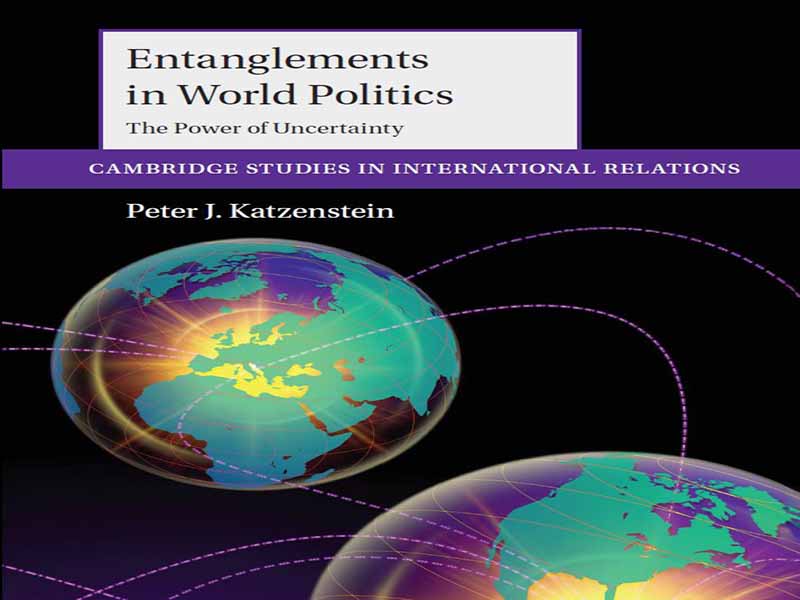
- عنوان کتاب: Entanglements in World Politics
- نویسنده: Peter J. Katzenstein
- حوزه: سیاست جهانی
- سال انتشار: 2026
- تعداد صفحه: 486
- زبان اصلی: انگلیسی
- نوع فایل: pdf
- حجم فایل: 5.78 مگابایت
این بیماری همهگیر با جدا کردن من از دیگران، اهمیت درهمتنیدگی را به من آموخت. با ترغیب به مطالعهی گستردهتر در تنهایی، در مورد طبیعت به عنوان «بانکی درهمتنیده» از شبکههای خویشاوندی آموختم. برای ریک کاربان، حشرهشناس، تحقیقات در مورد آگاهی و تجربهی گیاهان، حقایق کاملاً متفاوتی را ارائه نکرده است. جدید «تغییر در جهانبینی» است که از طریق آن حقایق تفسیر میشوند. زوئی شلانگر، نویسندهی علمی، مینویسد: «حیات زیستی، انتشار مارپیچی امکانات است.» فیزیکدانان کوانتومی به نتیجهی مشابهی رسیدهاند. در حالی که سادهسازی خوب است، جهان فیزیکی ساده نیست. در سطح زیراتمی، ذرات و امواج به جهانی رابطهای پر از پتانسیلها اشاره میکنند. کیهان مجموعهای از فرآیندهای درهمتنیده است که آیندهی خود را نمیداند. من که به رابطهی بین ریسک و عدم قطعیت علاقهمند هستم، از مسیری که علوم قرن بیستم ارائه میدهند، پیروی میکنم. مطالعهی گسترده باعث شده است که من به یک ضربالمثل منسوب به ماکس وبر اعتقاد راسخ داشته باشم: «من مزرعه ندارم – من الاغ نیستم.» اما با توجه به ریسک و عدم قطعیت به عنوان موضوع انتخابیام، یاد گرفتهام که یک ضربالمثل دیگر منسوب به لئو استاین، مجموعهدار آثار هنری و نویسنده، را بپذیرم: «سخت است آنقدر باهوش باشی که دقیقه بعد نتواند تو را فریب دهد.» گره خوردن شانس با سرنوشت، معمایی است که در این کتاب به آن میپردازم. پس از سالها تلاش، همچنان با حقیقت عمیقی که آتنیها در گفتگوی ملیان بیان کردند، دست و پنجه نرم میکنم، زمانی که آن را «امید، تسلیبخش خطر» مینامیدند. با این کتاب میخواهم به خوانندهام بگویم نه به چه فکر کند، بلکه به چه فکر کند. برای من، یک مطالعه جدی، بالاترین تعریفی است که هر نویسندهای میتواند به آن امیدوار باشد. من که مستعد پذیرش ندای اتحاد هیچ قبیلهای نیستم، در برابر کشش هر جهانبینی، پارادایم، رویکرد نظری، سنت مدلسازی یا روش واحدی مقاومت میکنم. گاهی اوقات، شجاعت اعتقادات کسانی را که دور پرچم منتخب خود جمع میشوند، در حالی که من بیهدف اینطرف و آنطرف میروم، تحسین میکنم. و گاهی اوقات، به همراهی همفکرانی که آشکارا از آن لذت میبرند، حسادت میکنم، در حالی که من به تنهایی در جنگل با سرعت زیاد راه خود را مییابم. من که در پایان جنگ جهانی دوم در آلمان متولد شدم، از ویژگیهای عجیب زندگینامهام این است که از جمعهایی که رفاقت را جشن میگیرند، متنفرم. من شیوهها و گفتگوهایی را ترجیح میدهم که زمینههای جدیدی را میگشایند تا آنهایی که آن را محصور و محدود میکنند. من عمیقاً نسبت به مهندسی سیاسی، جهشهای بزرگ و راهحلهای نهایی بدبین هستم. دوست دارم از بسیاری از افرادی که به روشهای مختلف و در مراحل مختلف، در حین نوشتن این کتاب، به من آموزش دادند و راهنماییام کردند، تجلیل و تشکر کنم. کمک آنها بار دیگر مرا به شدت از همکاری و رفاقتی که جوامع محققان را تعریف میکند و شامل کالج نامرئی کسانی که قبلاً آمدهاند و کسانی که بعداً خواهند آمد، میشود، آگاه کرد. یادگیری جمعی و مشترک است، نوشتن فردی و تنها. استیو نلسون در مجموعهای از مقالات که به بحران مالی سال ۲۰۰۸ میپرداخت، همکاری داشت. آن رویداد بیش از هر یک از همکارانم مرا شوکه کرد. بخش عمدهای از آنچه از او و با او آموختم، بخشی از فصل ۴ این کتاب است. رودرا سیل به من در درک التقاطگرایی و عملگرایی کمک کرد، که ما در کتاب «فراتر از پارادایمها: التقاطگرایی تحلیلی در سیاست جهانی» (۲۰۱۰) و چندین مقاله به بررسی آنها پرداختیم. نوشته مشترک ما روح این کتاب را شکل میدهد و به صراحت در فصل پایانی آن آمده است. مرحوم لوسیا سیبرت، که آخرین مراحل زندگی خود را با شجاعت و وقار فراوان سپری میکرد، در حالی که بیماری قدرتش را تحلیل میبرد، حقیقت عمیقی را در مورد قدرت امید به من آموخت. خلاصه همکاری ما در کتاب «قدرت متغیر» (۲۰۱۸) و کار تجربی مهم همکاران ما که به استدلالهای نظری ما جان بخشیدند – راوی عبدالعلال، پیتر آندریاس، فیلیپ ایوب، نوئل بریگدن، جنیفر اریکسون، جسیکا گرین، ارین لاکوود، باراک مندلسون، استیون نلسون و کریستین رویس-اسمیت – در فصل ۷ گزارش شده است. ژاک هایمانز شماره ویژهای از مجله «نظریه بینالمللی» (۲۰۲۰) را سازماندهی و معرفی کرد. من از مقالات ژرف امانوئل آدلر، جورج دمارتینو و ایلن گرابل، استفانو گوزینی، بنوا پلوپیداس و مایکل زورن چیزهای زیادی آموختم. بخش عمدهای از آنچه در مورد جهانبینیها آموختم از کتاب «عدم قطعیت و نارضایتی از آن» (۲۰۲۲) حاصل شد، پروژهای که با مشارکت فکری کامل بنتلی آلن، مایکل بارنت، تیموتی بیرنز، پراسنجیت دوارا، جایروس گروو، مارک هاس، میلجا کورکی و هنری ناو امکانپذیر شد. برخی از مطالب کوتاه در بخشهایی از فصلهای ۱ و ۲ گزارش شدهاند. در صورت لزوم، در بخشهای مختلف این کتاب به برخی از آثار منتشر شده قبلیام اشاره کردهام. این تنها آغاز فهرست طولانی همکارانی است که در نگارش این کتاب به من کمک کردند. من نظرات ارزشمندی در مورد بخشهای فصلها، فصلها و نسخههای مختلف کل نسخه خطی از راوی عبدالعل، اوریل ابولف، امانوئل آدلر، ماتیاس آلبرت، بنتلی آلن، آملیا آرسنالت، فیل ایوب، مایکل بارنت، کاوشیک باسو، دیوید بیتمن، الکساندرا بلکمن، برت د باری، استیون برنشتاین، نوئل بریگدن، تیموتی بیرنز، الکساندرا سیرون، جیمز دیویس، تیم دووگد، دونا دیکنسون، پراسنجیت دوارا، پیتر … دریافت کردهام.
In separating me from others, the pandemic taught me the importance of entanglement. Enticed to read more broadly in solitude, I learned about nature as an “entangled bank” of webs of affinities. For entomologist Rick Karban, research about plant awareness and experience has not presented radically different facts. New is “the change in worldview” through which the facts are interpreted. “Biological life,” writes science writer Zoë Schlanger, “is a spiraling diffusion of possibilities.” Quantum physicists have come to a similar conclusion. While it is nice to simplify, the physical world is not simple. At the subatomic level, particles and waves point to a relational world filled with potentialities. The cosmos is a set of entangled processes that does not know its own future. Interested in the relation between risk and uncertainty, I am following the lead twentieth-century sciences provide. Reading broadly has made me a firm believer in a bon mot attributed to Max Weber: “I do not have a field – I am not a donkey.” But with risk and uncertainty as my chosen subject I have learned to accept another bon mot attributed to art collector and writer Leo Stein: “It’s hard to be so smart that the next minute can’t fool you.” The entangling of chance with fate poses the conundrum I discuss in this book. After many years of trying, I continue to struggle with the deep truth the Athenians expressed in the Melian Dialogue when they called “hope danger’s comforter.” With this book I want to tell my reader not what to think but what to think about. A serious reading is for me the highest compliment any author can hope for. Not predisposed to any tribe’s uniting call, I resist the pull of any one worldview, paradigm, theoretical approach, modeling tradition, or method. I admire, sometimes, the courage of the convictions of those who rally around their chosen flag while I flap around aimlessly. And I envy, sometimes, the companionship the like-minded so evidently enjoy as I bushwhack my way through the jungle alone. Born in Germany at the end ofWorld War II, it is a quirk of my biography that I abhor collectives celebrating companionship. I prefer practices and conversations that open up new terrain to those that fence it in and close it down. I am deeply skeptical of political engineering, big leaps, and final solutions. I like to celebrate and thank the many people who taught and tutored me in different ways and at different stages, as I was writing this book. Their help made me acutely aware, once again, of the collegiality and camaraderie that define communities of scholars and that include the invisible college of those who came before and those who will come after. Learning is collective and shared, writing is individual and lonely. Steve Nelson was a collaborator on a set of papers that dealt with the financial crisis of 2008. That event shocked me more than any of my colleagues. Much of what I learned from and with him is part of Chapter 4 in this book. Rudra Sil helped me understand eclecticism and pragmatism, which we explored in Beyond Paradigms: Analytic Eclecticism in World Politics (2010) and several articles. Our collaborative writing informs the spirit of this book and appears explicitly in its concluding chapter. Living the last stages of her life with enormous courage and grace as illness drained her strength, the late Lucia Seybert taught me a deep truth about the power of hope. The gist of our collaboration in Protean Power (2018) and the important empirical work of our collaborators who put flesh on the bones of our theoretical arguments – Rawi Abdelal, Peter Andreas, Philip Ayoub, Noelle Brigden, Jennifer Erickson, Jessica Green, Erin Lockwood, Barak Mendelsohn, Stephen Nelson, and Christian Reus-Smit – are reported in Chapter 7. Jacques Hymans organized and introduced a special issue of International Theory (2020). I learned a great deal from the insightful papers of Emanuel Adler, George DeMartino and Ilene Grabel, Stefano Guzzini, Benoît Pelopidas, and Michael Zürn. Much of what I learned about worldviews came from Uncertainty and Its Discontent (2022), a project made possible by the full intellectual engagement of Bentley Allan, Michael Barnett, Timothy Byrnes, Prasenjit Duara, Jairus Grove, Mark Haas, Milja Kurki, and Henry Nau. Some snippets are reported in portions of Chapters 1 and 2. Where relevant, I have referred in various parts of this book to some of my prior publications. This is only the beginning of a long list of colleagues who helped me with this book. I have received invaluable comments on chapter segments, chapters, and different versions of the whole manuscript from Rawi Abdelal, Uriel Abulof, Emanuel Adler, Mathias Albert, Bentley Allan, Amelia Arsenault, Phil Ayoub, Michael Barnett, Kaushik Basu, David Bateman, Alexandra Blackman, Brett de Bary, Steven Bernstein, Noelle Brigden, Timothy Byrnes, Alexandra Cirone, James Davis, Tim Devoogd, Donna Dickenson, Prasenjit Duara, Peter Enns, Jennifer Erickson, Matthew Evangelista, Anna-Katharina Ferl, Rainer Forst, Jill Frank, Peter Gourevitch, Ilene Grabel, Jessica Green, Jairus Grove, Stefano Guzzini, Mark Haas, Peter Haas, Gunther Hellmann, Douglas Holmes, Aida Hozic, Steffen Huck, Macartan Humphreys, Patrick Jackson, Bruce Jentleson, Stephen Kalberg, Sabrina Karim, Mary Katzenstein, Robert Keohane, Jonathan Kirshner, Sarah Kreps, Douglas Kriner, Milja Kurki, David Lake, David Laitin, Adam Lerner, Adam Levine, Phil Lewis, Erin Lockwood, Patchen Markell, Michael Marks, Sally McConnell-Ginet, Barak Mendelsohn, Cheryl Misak, Franziska Müller, Henry Nau, Joseph Nye, Lou Pauly, Reid Pauly, Benoît Pelopidas, Kai Quek, Christian Rauh, Judith Reppy, Bryn Rosenfeld, Christian Reus-Smit, Scott Sagan, Wayne Sandholtz, Fritz Scharpf, Rebecca Slayton, Hendrik Schopmans, Rudra Sil, Janice Stein, Wolfgang Streeck, Sidney Tarrow, Geoffrey Wallace, Jeremy Wallace, Christopher Way, Zellman Warhaft, David Welch, and Anna Wojciuk. I thank them for their helpful conversations, insightful comments, sharp criticisms, and extensive reviews. I apologize to those whose names I failed to record properly and list here. I also thank the participants of workshops convened by Cornell’s Government Department, Duke University, the European University Institute, the Hertie School of Berlin, the Universities of Frankfurt and Toronto, the Max-Planck Institute for the Study of Societies at Cologne, and theWZBBerlin Social Science Center for their engaged participation and critical comments on different chapters of this book. Two anonymous readers for Cambridge University Press gave the manuscript an engaged reading that proved very helpful in the final revisions of the manuscript. In the writing of this book I have gratefully relied on Wikipedia for initial orientations or verifications. I have refrained from seeking assistance from any version of AI or Chatbot. Naomi Egel, Jordan Ecker, and Musckaan Chauhaan served as extremely resourceful and helpful research assistants at different stages of the project. Junyang Hu and Jake Swanson became indispensable colleagues. For several years Junyang Hu helped me with unfailing efficiency to master all kinds of tasks, small and large, that reminded me of the advertisement I once saw in a small shop: “the impossible we do right away; miracles take a little longer.” Jake covered an enormously wide field of topics which, falling woefully short of full mastery, I needed to get to know. Over several years we talked as he tutored me how language should and could be integrated as a crucial part of the book’s argument. Both Junyang and Jake commanded a preternatural reservoir of empathy that made them strike the proper balance of criticism and encouragement as I was struggling with the material and putting pen to paper. Patrick Jackson taught me that it takes repetition to fully internalize rather than merely hear the simple, big point. Although our destinations differed, we have traveled on adjacent roads. At a crucial point toward the end of the project, with my spirit flagging, Janice Stein appeared like a Saint, sounding the trumpet and pointing out some of my discordant notes. Her support went far beyond assent and criticism and helped propel me across the finish line. After more than forty years of collaborative work with one of the best social science editors of the past generation, I have admired, once again, what Roger Haydon can do with the English language. He was entirely correct when he wrote at the end “I have read every word of this,” which was his way of saying “this book is too long,” while also understanding fully why it could not be shorter. I have once again been the beneficiary of the superb editorial staff at Cambridge University Press. John Haslam was totally supportive of this conclusion to a trilogy comprising also Protean Power (2018) and Uncertainty and Its Discontents (2022). Carrie Parkinson and Claire Sissen made sure that the train was always on the right track and running on time. And the incomparable Julene Knox demonstrated time and again that computer-assisted copy-editing remains both craft and art. I thank them all for making the production of this book such an unproblematic venture.
این کتاب را میتوانید از لینک زیر بصورت رایگان دانلود کنید:
Download: Entanglements in World Politics


















نظرات کاربران