













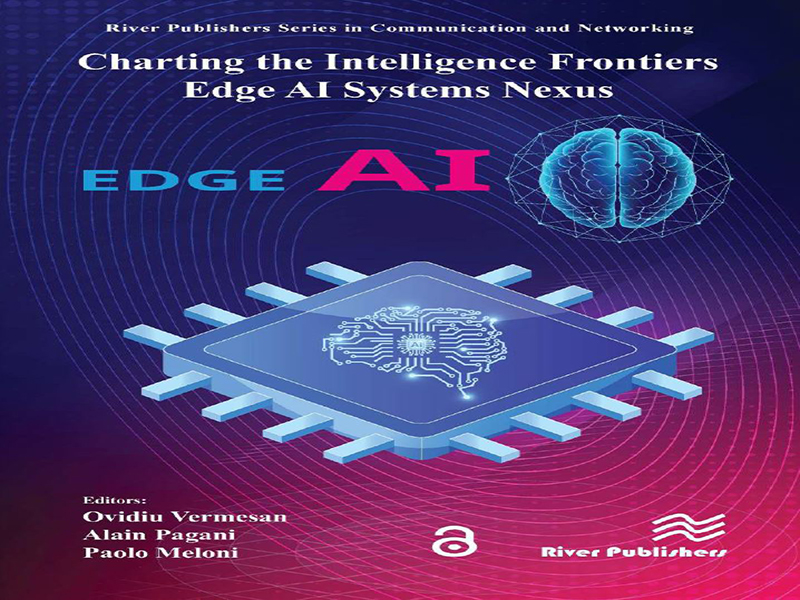
- عنوان کتاب: Charting the Intelligence Frontiers – Edge AI Systems Nexus
- نویسنده: Ovidiu Vermesan, Alain Pagani, Paolo Meloni
- حوزه: هوش مصنوعی لبه
- سال انتشار: 2025
- تعداد صفحه: 449
- زبان اصلی: انگلیسی
- نوع فایل: pdf
- حجم فایل: 7.49 مگابایت
این کتاب حاصل تبادل غنی ایدهها و ارائهها در کنفرانس اروپایی فناوریها و کاربردهای هوش مصنوعی لبه (EEAI) است که در تاریخ ۲۱ تا ۲۳ اکتبر ۲۰۲۴ در کالیاری، ساردینیا، ایتالیا برگزار شد و نگاهی اجمالی و عمیق به چشمانداز معاصر هوش مصنوعی لبه ارائه میدهد. این کتاب با بیست فصل منتخب، همگرایی مفاهیم بنیادی، پیشرفتهای فنی و استقرارهای دنیای واقعی را که پیوستار هوش مصنوعی لبه را تعریف میکنند، در بر میگیرد. در مجموع، این کتاب به عنوان مرجعی برای این حوزه عمل میکند و جدیدترین روندهای فعلی و پیشبینی روندهای آینده در ابرخودکارسازی، هوش مصنوعی مولد، اتصال، خودمختاری و معماریهای مش امنیتی را به تصویر میکشد. چه به دنبال دانش فنی عمیق، الهامبخشی برای کاربردهای جدید یا مروری استراتژیک بر چشمانداز هوش مصنوعی لبه باشید، بینشهای ارزشمندی از محققان و متخصصان فکری در خط مقدم حوزه هوش مصنوعی لبه خواهید یافت. در ادامه، مروری مختصر بر هر یک از بیست فصل ارائه شده است که تحقیقات و کاربردهای هوش مصنوعی لبهای را برجسته میکند و بر تعهد کتاب به تأثیر فناوری و اجتماعی تأکید دارد. تأیید و اعتبارسنجی سیستمهای هوش مصنوعی لبهای: این فصل به بررسی چالشهای تأیید و اعتبارسنجی سیستمهای پیچیده هوش مصنوعی لبهای میپردازد که سختافزار، نرمافزار و دادهها را ادغام میکنند. این فصل یک چارچوب ساختاریافته را پیشنهاد میدهد که مهندسی مبتنی بر مدل و داده را ترکیب میکند تا اطمینان حاصل شود که این سیستمها قابل اعتماد، قوی و مطابق با استانداردهای نظارتی هستند. پیشگامی در هیبریداسیون یادگیری فدرال: این کار یک چارچوب یادگیری فدرالی ترکیبی را برای تشخیص فعالیت انسانی معرفی میکند، که در آن برخی از مشتریان موافقت میکنند بخشی از دادههای خود را به اشتراک بگذارند. این تحقیق ارزیابی میکند که آیا این اشتراکگذاری جزئی دادهها میتواند دقت طبقهبندی کلی مدل جمعی را در عین حفظ حریم خصوصی کاربر بهبود بخشد یا خیر. معماری هوش لبهای برای یادگیری توزیعشده و فدرالی: این فصل با ترکیب یادگیری فدرالی، تقطیر دانش و فشردهسازی مدل، یک معماری جدید برای نظارت بر وسایل نقلیه الکتریکی (EV) ارائه میدهد. این رویکرد امکان ایجاد مدلهای هوش مصنوعی کارآمد و با حفظ حریم خصوصی را فراهم میکند که میتوانند در دستگاههای لبه با محدودیت منابع برای کاربردهایی مانند نگهداری پیشبینیکننده مستقر شوند. چالشها و عملکرد الگوریتمهای SLAM در دستگاههای با محدودیت منابع: این مطالعه عملکرد الگوریتمهای مختلف SLAM (محلیسازی و نقشهبرداری همزمان) مبتنی بر تصویر را بر روی سختافزارهای با محدودیت منابع، مانند NVIDIA Jetson، ارزیابی میکند. این مطالعه چندین سیستم مبتنی بر یادگیری عمیق را بر اساس معیارهایی مانند دقت، مصرف انرژی و استفاده از منابع برای ارزیابی قابلیت حیات آنها در دنیای واقعی محک میزند. طراحی سیستمهای هوش مصنوعی لبه شتابیافته با روششناسی مبتنی بر مدل: این فصل یک روششناسی مهندسی سیستم سایبرترونیک مبتنی بر مدل (MBCSE) را برای طراحی سیستمهای هوش مصنوعی لبه بهینه با شتابدهندههای سختافزاری سفارشی ارائه میدهد. این رویکرد یک تحلیل جامع را امکانپذیر میکند که عملکرد، قدرت و هزینه را متعادل میکند و تضمین میکند که الگوریتمهای هوش مصنوعی میتوانند به طور مؤثر در محدودیتهای سیستمی سختگیرانه مستقر شوند. شتابدهی هوش مصنوعی لبهای برای سیستمهای حیاتی: این اثر با تمرکز بر محیط طاقتفرسای ماهوارهها، راهحلهای سختافزاری مانند FPGAها و CGRAها را برای پردازش هوش مصنوعی خودکار و بلادرنگ مورد بحث قرار میدهد. این تحقیق به چالشهای حیاتی سیستم، از جمله محدودیتهای توان و تحمل تابش، میپردازد و جزئیات طراحی یک GPU مبتنی بر FPGA و یک چارچوب شتابدهنده هوش مصنوعی را شرح میدهد. انتخاب مدل و استراتژیهای تحریک برای سیستمهای رباتیک مبتنی بر LLM: این فصل چالشهای انتخاب و پیادهسازی مدلهای زبان بزرگ (LLM) را در سیستمهای رباتیک با محدودیت منابع بررسی میکند. این فصل تأکید میکند که تغییر وزن یا دقت مدل اغلب نیاز به اصلاحات قابل توجهی در استراتژیهای تحریک دارد و توسعه سیستمهای مدولار و بدون وزن را پیچیده میکند. بهینهسازی ViT برای استقرار لبه: این تحقیق یک روش کاهش توکن ترکیبی را ارائه میدهد که ادغام توکن و هرس را با هم ترکیب میکند تا ترانسفورماتورهای بینایی (ViT) را برای تقسیمبندی معنایی در دستگاههای لبهای کارآمدتر کند. این رویکرد پیچیدگی محاسباتی را تنها با حداقل افت دقت کاهش میدهد، اگرچه چالشهایی را در صادرات مدلهای هرس شده برجسته میکند. روندهای اخیر در هوش مصنوعی لبهای: این فصل مروری جامع بر تکنیکهای اخیر برای طراحی، آموزش و استقرار کارآمد مدلهای یادگیری ماشین در دستگاههای لبهای ارائه میدهد. این فصل معماریهای مقیاسپذیر، جستجوی معماری عصبی و روشهای فشردهسازی، مانند کوانتیزاسیون و هرس کردن، را برای فعال کردن هوش مصنوعی با بهرهوری انرژی در محیطهای با منابع محدود پوشش میدهد. ادغام حسگر مقیاسپذیر برای محلیسازی حرکت در شبکههای حسگر RF بزرگ: این کار با استفاده از یک مدل احتمالاتی، به چالش محلیسازی دقیق حرکت در شبکههای حسگر بیسیم در مقیاس بزرگ میپردازد. این نشان میدهد که تکنیکهای بیزی متغیر، یک راهحل مقیاسپذیر برای ادغام حسگر ارائه میدهند و بهروزرسانیهای محلی را که اثرات غیرمحلی را به طور مؤثر مدلسازی میکنند، امکانپذیر میکنند.
This book is the result of the rich exchanges of ideas and presentations at the European Conference on EDGE AI Technologies and Applications (EEAI) held on 21-23 October 2024 in Cagliari, Sardinia, Italy, offering a panoramic snapshot and a technical deep dive into the contemporary landscape of edge AI. With twenty selected chapters, it encapsulates the convergence of fundamental concepts, technical advancements, and real-world deployments that define the edge AI continuum. Collectively, the book serves as a reference for the field, capturing the current state-of-the-art and anticipating future trends in hyperautomation, generative AI, connectivity, autonomy, and security mesh architectures. Whether you are seeking in-depth technical knowledge, inspiration for novel applications, or a strategic overview of the edge AI landscape, you will find invaluable insights from thought researchers and practitioners at the forefront of the field of edge AI. A brief overview of each of the twenty chapters is provided below, highlighting the research and applications of edge AI that underscore the book’s commitment to both technological and societal impact. Edge AI Systems Verification and Validation: This chapter explores the challenges of verifying and validating complex edge AI systems, which integrate hardware, software, and data. It proposes a structured framework that combines model- and data-driven engineering to ensure these systems are reliable, robust, and meet regulatory standards. Pioneering the Hybridization of Federated Learning: This work introduces a hybrid federated learning framework for human activity recognition, where some clients agree to share a portion of their data. The research assesses whether this partial data sharing can improve the overall classification accuracy of the collective model while maintaining user privacy. Edge Intelligence Architecture for Distributed and Federated Learning: This chapter proposes a novel architecture for monitoring Electric Vehicles (EVs) by combining Federated Learning, Knowledge Distillation, and model compression. This approach enables the creation of efficient, privacy-preserving AI models that can be deployed on resource-constrained edge devices for applications like predictive maintenance. Challenges and Performance of SLAM Algorithms on ResourceConstrained Devices: This study evaluates the performance of various visual-based SLAM (Simultaneous Localisation and Mapping) algorithms on resourceconstrained hardware, such as the NVIDIA Jetson. It benchmarks several deep learning-based systems on metrics such as accuracy, energy consumption, and resource usage to assess their real-world viability. Designing Accelerated Edge AI Systems with ModelBased Methodology: This chapter presents a Model-Based Cybertronic System Engineering (MBCSE) methodology for designing optimal edge AI systems with bespoke hardware accelerators. This approach enables a holistic analysis that balances performance, power, and cost, ensuring AI algorithms can be deployed effectively within tight system constraints. Edge AI Acceleration for Critical Systems: Focusing on the demanding environment of satellites, this work discusses hardware solutions, such as FPGAs and CGRAs, for real-time, autonomous AI processing. The research addresses critical system challenges, including power constraints and radiation tolerance, and details the design of an FPGA-based GPU and an AI accelerator framework. Model Selection and Prompting Strategies for LLMBased Robotic Systems: This chapter examines the challenges of selecting and implementing Large Language Models (LLMs) in resource-constrained robotic systems. It highlights that changing model weights or precision often requires significant modifications to prompting strategies, complicating the development of modular, weight-agnostic systems. Optimising ViT for Edge Deployment: This research presents a hybrid token reduction method, combining token merging and pruning, to make Vision Transformers (ViT) more efficient for semantic segmentation on edge devices. This approach significantly reduces computational complexity with only a minimal drop in accuracy, though it highlights challenges in exporting pruned models. Recent Trends in Edge AI: This chapter provides a comprehensive overview of recent techniques for efficiently designing, training, and deploying machine learning models on edge devices. It covers scalable architectures, neural architecture search, and compression methods, such as quantisation and pruning, to enable energy-efficient AI in resource-limited environments. Scalable Sensor Fusion for Motion Localization in Large RF Sensing Networks: This work addresses the challenge of accurate motion localisation in large-scale wireless sensing networks by using a probabilistic model. It demonstrates that variational Bayesian techniques offer a scalable solution for sensor fusion, enabling localised updates that model non-local effects efficiently. MultiStep Object ReIdentification on Edge Devices: This chapter proposes a pipeline for vehicle re-identification on edge devices using a multi-step feature extraction and matching process. The system detects an object, converts it to a vector embedding, and queries a database to find matches, achieving high precision in real-world camera network scenarios. A TinyMLOps Framework for RealWorld Applications: This work introduces a TinyMLOps framework to streamline the optimisation and deployment of AI models on microcontrollers. The framework uses cloud resources for intensive tasks while gathering real-time performance metrics from target devices, ensuring an accurate and scalable solution for deploying AI in constrained environments. Transfer and SelfLearning in Probabilistic Models: This chapter explores the integration of transfer-learning and self-learning techniques within a single probabilistic model. The research finds that this synergy can be achieved through prior optimisation, enabling models to adapt across different environments where they are deployed. A Novel Hierarchical Approach for OnDevice Energy Efficient Fault Classification: This work proposes a hierarchical architecture utilising multiple smaller neural networks to perform energy-efficient fault classification directly on edge devices. By dividing the problem into smaller sub-tasks, the approach achieves a nine-fold reduction in energy consumption with comparable accuracy to a non-hierarchical model. Discovering and Classifying Defects at the Edge: This chapter presents an AIbased optical inspection solution for detecting defects in digital and wooden industry products. Using YOLO and ResNet models deployed on edge devices, the system achieves high accuracy in identifying defect positions and classifying defect types, with explainability tools clarifying the model’s decisions. Conscious Agents Interaction Framework for Industrial Automation: This paper examines the integration of human cognitive models into industrial automation, aiming to create flexible, multi-agent systems where humans and machines collaborate as equal partners. Case studies in vertical farming and HVAC control demonstrate how agents can reason and negotiate to achieve both collective and individual goals. Neuromorphic IoT Architecture for Efficient Water Management: This work proposes a neuromorphic IoT architecture inspired by biological systems to address the energy and communication challenges of traditional IoT networks. A case study on water management demonstrates how this eventdriven, asynchronous approach can be realised with neuromorphic hardware to create a more efficient and responsive system. Online AI Benchmarking on Remote Board Farms: This project aims to create a collaborative platform, dAIEdge – VLab, that enables researchers to benchmark AI models on a range of remote edge devices. This virtual laboratory will provide access to shared resources and tools, enabling users without deep-embedded expertise to conduct live AI experiments. Optimising Neural Networks for Water Stress Prediction in Europe: This study compares various neural network architectures and optimisers to predict water stress, a key sustainability indicator accurately. The findings show that a three-layer architecture with an Adam optimiser provides the highest accuracy, offering a valuable tool for informed water resource management. Decentralising Key Generation in CLPKC with Traceable Ring Signatures: This chapter addresses a key vulnerability in Federated Learning by proposing a mechanism to decentralise key generation in Certificateless Public Key Cryptography. Using traceable ring signatures and blockchain infrastructure, the model provides accountability and disincentivises malicious behaviour among trusted authorities.
این کتاب را میتوانید از لینک زیر بصورت رایگان دانلود کنید:
Download: Charting the Intelligence Frontiers – Edge AI Systems Nexus

























نظرات کاربران